
 Climate
 Privacy
 Bob Dylan
 Drones
 Data Centers
 AI Governance
 2026 Maine Senate Race
Thermal Drones Expand Search Operations
Coverage from ABC News, WMTV15 News, and others
Articles
22
Active Days
93
The Topic
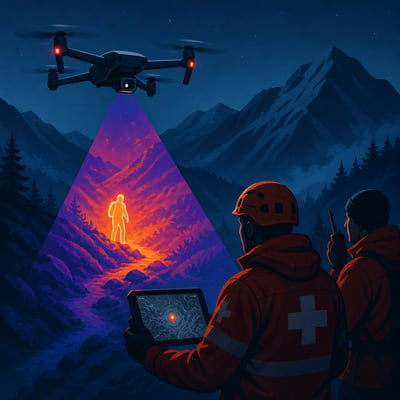
Thermal-equipped drones are being used by police, fire services, and wildlife volunteers to find people or animals hidden by darkness, vegetation, or terrain. The aircraft typically narrow search areas and guide ground teams, complementing officers, K-9 units, helicopters, and other responders rather than replacing them. The reporting also shows public-safety drone programs expanding through rapid-launch systems, shared aircraft, AI-assisted detection, and purpose-built equipment, while procurement restrictions affect some U.S. agencies.
First Article: 04/27/26
Latest Article: 07/28/26
Summary
- Thermal cameras located missing or hiding people in woods, fields, corn, tall grass, and mountain terrain across Australia and the United States.
- Fire and rescue crews used an AI-enabled drone, thermal imaging, and an onboard speaker to find two hikers in Kosciuszko National Park and guide them out.
- Police agencies used drones alongside K-9 teams, helicopters, search crews, and medical responders, showing a complementary role in complex operations.
- Rapid-launch drone docks and larger agency fleets are making thermal search capability available for recurring emergencies across large jurisdictions.
- A Bavarian volunteer group says DJI thermal drones increased annual fawn rescues from roughly 10–15 to 300–350, while Germany provides equipment subsidies and eased relevant rules.
- U.S. federal restrictions on DJI and other Chinese-made drones create equipment constraints for agencies such as the FBI.
History
The story now places much greater emphasis on operational scale and program maturity, highlighting large agency fleets, rapid-launch docks, and recurring deployment capability. It also adds a clearer regulatory and procurement constraint angle, especially U.S. restrictions on Chinese-made drones and Germany’s supportive policy environment for wildlife rescue.
The story broadens from wildlife and general public-safety drone use into a more operationally detailed account of multi-agency search programs, with AI-assisted detection, automated docks, and mutual-aid deployment now central to the narrative. It also adds clearer limits on where these systems work best and where they remain constrained.
Featured
Timeline: 93 Days
Hover over any logo to see coverage summary, click for full article.