
 Climate
 Privacy
 Bob Dylan
 Drones
 Data Centers
 AI Governance
 2026 Maine Senate Race
World Cup Counter-Drone Security
Coverage from The Jerusalem Post, Yahoo, and others
00/00/0000
Articles
25
Active Days
82
The Topic
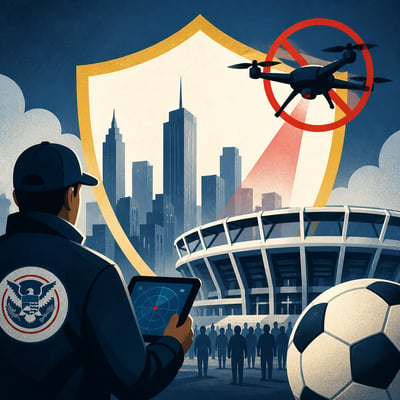
U.S. federal, state, and local authorities are deploying counter-drone systems, training officers, and enforcing temporary flight restrictions across World Cup venues in the United States, Mexico, and Canada. More than 1,000 drone detections and hundreds of mitigations or seizures have been reported at tournament-related sites, while FEMA funding and DHS technical support are expanding local capabilities. The effort is also exposing coordination, training-capacity, interoperability, and technology gaps, particularly against inexpensive cellular-controlled or improvised drones.
First Article: 05/07/26
Latest Article: 07/27/26
History
The story is mostly unchanged, but it is now more specific about the scale of drone activity and the defensive technology mix. It also adds a new commercial vendor presence at venues, suggesting a broader real-world deployment footprint.
The story has expanded from general World Cup drone enforcement into a larger, more operationally detailed counter-UAS campaign with concrete incident counts, major FEMA funding, and explicit training and interoperability limits. It now also extends beyond U.S. venues to the broader North American tournament footprint and a more developed discussion of technical constraints.
- More than 1,000 drone detections and 300 mitigations were reported by late June.
- FEMA distributed $250 million to 11 host states and the National Capital Region.
- The FBI’s counter-UAS training demand reportedly exceeded certification capacity.
- The operational scope now includes Mexico and Canada.
- Urban interference and homemade FPV drones are complicating detection and mitigation.
The story now emphasizes active, ongoing enforcement during the tournament, not just pre-event preparation, with reported drone incidents and seizures showing the restrictions are being used in practice. It also adds a new angle: drone-security messaging itself is being muddled by disputed or false claims.
- Hundreds of drone incidents and seizures were reported near host-city sites.
- FBI and DHS are sharing interception and pilot interview responsibilities.
- Security now covers team hotels, training camps, and base camps.
- Funding supports multi-year counter-drone programs across host states.
- A disputed Handala claim shows recycled or false drone-security messaging.
The story has broadened from general World Cup counter-drone preparations to a more explicit, operational security campaign centered on real deployments, enforcement, and procurement across U.S. host cities. The current version also adds several vendors and emphasizes passive/non-kinetic systems and adjacent cyber concerns.
The story has shifted from planning to visible execution: enforcement is now happening at World Cup venues, with drone citations and seizures showing restrictions are being actively applied. At the same time, a separate hacking-claim thread has emerged, but it appears disputed and secondary to the core security buildout.
- Drone citations and seizures have already occurred near World Cup venues.
- FBI training centers and ground intercept teams are expanding enforcement capacity.
- Disputed claims about hacked FBI drones have surfaced in separate reporting.
- Procurement now includes named sensors and remote-response systems.
- State and local host-city agencies are more explicitly part of operations.
The story has moved from general counter-UAS planning to visible operational execution, with agencies now layering federal funding, FAA restrictions, law-enforcement procedures, and actual procurement/deployment activity around World Cup venues. The coverage also expands beyond Texas into a broader multi-agency, multi-city security effort and adds clearer procurement and enforcement details.
- FAA temporary flight restrictions are being used around World Cup venues.
- Criminal penalties are being emphasized for unauthorized drone activity.
- Law enforcement response now includes pilot contact, seizure, and prosecution referrals.
- DHS is providing vendor-agnostic procurement tools and scorecards.
- Local agencies are actively purchasing detection and mitigation systems.
The story has shifted from general World Cup counter-drone planning to concrete operational deployment, with Texas DPS now actively using RF monitoring and FAA Remote ID to detect and track drones. The current version also broadens the security picture by emphasizing host-city airspace protection and the role of commercial drone repurposing risk.
- Texas DPS is deploying RF monitoring and FAA Remote ID detection.
- Security focus now includes stadiums, fan zones, and transit hubs.
- Commercial drones may be repurposed near crowded venues.
- Operational readiness is now the strongest signal in the story.
The story now places counter-UAS work more firmly in active procurement and deployment, not just preparation, with specific emphasis on vendor comparison tools and operational site assessments. It also adds a clearer procurement-policy angle around NDAA-compliant or American-made systems.
The story broadens beyond World Cup procurement into a wider counter-drone readiness push for other security-sensitive sites, while industry voices add a new debate over acceptable drone platforms and supply chains. The operational focus remains the same, but the framing now emphasizes deployment readiness and procurement choices more explicitly.
The story is largely the same, but it now looks more like an active procurement-and-deployment framework than a general preparedness discussion. The updated version adds named agency leadership, a larger funding figure, and more explicit layered counter-drone tactics.
The story is largely stable, but the framing has sharpened around commercial heavy-lift drones as a realistic venue-security threat. Procurement is also being more explicitly tied to interoperability, cost, and compliance constraints such as NDAA and Blue List rules.
The story broadened from World Cup-specific counter-UAS planning to a wider procurement and deployment framework for high-value sites, with stronger emphasis on practical field implementation. The update also adds clearer concern about procurement restrictions and the safety tradeoffs of interdiction methods.
- NUSTL is providing a vendor-agnostic counter-UAS purchasing tool.
- FEMA grants support counter-drone purchases and officer training.
- Planning now includes line-of-sight and RF survey analysis.
- The framework is being extended to airports, utilities, and correctional facilities.
- Operational risks from jamming and kinetic response are now explicitly discussed.
The story now includes a stronger commercial-industry angle: drone makers are publicly shaping the counter-UAS conversation by promoting NDAA-aligned platforms and layered security features for World Cup venue protection. It also broadens the operational framing from general host-city planning to specific high-risk venue types like fan zones and transit hubs.
DHS and FEMA are helping World Cup host cities prepare for drone-related security risks by funding counter-UAS purchases, providing procurement guidance, and supporting site-specific planning. The main emphasis is on helping public safety agencies choose systems that fit dense urban venues and coordinate them effectively across jurisdictions. The topic also reflects broader concern about protecting major events where drone detection exists but mitigation and deployment gaps remain.