
 Climate
 Privacy
 Bob Dylan
 Drones
 Data Centers
 AI Governance
 2026 Maine Senate Race
AI Surveillance Expands Across Campuses
Coverage from Security Boulevard, Washington Post, and others
Articles
38
Active Days
166
The Topic
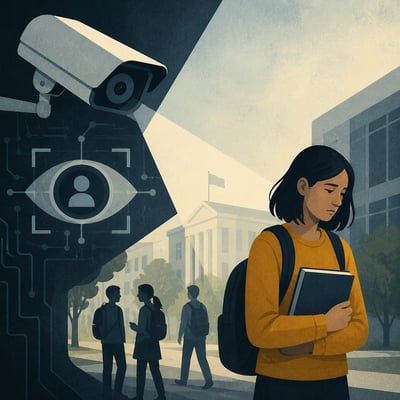
Universities, school districts, and U.S. authorities are deploying larger networks of AI-enabled cameras, biometric systems, video analytics, and related sensors in campuses, schools, stadiums, and public spaces. The systems are promoted for security, threat detection, emergency response, and operational efficiency, but their expansion is generating concerns about undisclosed capabilities, facial recognition, data retention, sharing with law enforcement, and the risk that temporary event monitoring becomes permanent infrastructure. A recurring tension is that vendors advertise broad analytical capabilities while institutions often state that only narrower functions are currently enabled.
First Article: 02/13/26
Latest Article: 07/28/26
Summary
- MIT, SDSU, and Chico Unified are deploying or operating hundreds to more than 1,300 AI-capable cameras across academic, residential, and public areas.
- Vendor systems can support facial recognition, license-plate identification, object and behavior analysis, audio detection, and searchable video, although institutions say some capabilities are disabled or unused.
- World Cup and America250 security planning is expanding camera, biometric, audio-detection, license-plate, and intelligence-sharing systems across host cities and stadiums.
- Student, parent, and civil-liberties concerns focus on limited disclosure, surveillance in housing and schools, unclear retention and sharing rules, and possible future activation of facial recognition.
- The material shows a recurring gap between technical capability and stated operational use, making oversight and verification difficult.
- Some event-surveillance systems are being positioned as test or deployment platforms for future large public events, including the 2028 Los Angeles Olympics.
History
The story has broadened from campus and school surveillance to a wider public-event and homeland-security picture, with new emphasis on how large-scale deployments may persist beyond temporary events. It also more clearly frames the gap between vendors’ broad technical capabilities and what institutions say is actually enabled.
The story has shifted from broad concerns about AI monitoring across schools and homes to a more concrete wave of large-scale surveillance deployments in U.S. campuses and major-event security. The new emphasis is on specific institutions, vendors, and law-enforcement data sharing, which makes the privacy and permanence risks more immediate.
Featured
Timeline: 166 Days
Hover over any logo to see coverage summary, click for full article.