History
07/23/20260 new articles
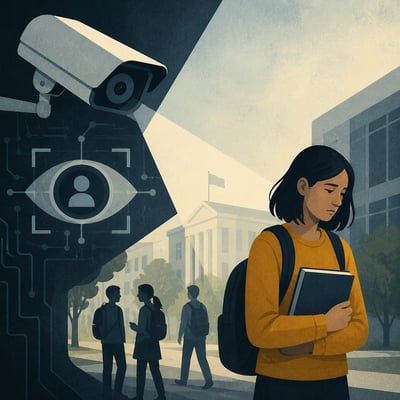
The story has broadened from campus and school surveillance to a wider public-event and homeland-security picture, with new emphasis on how large-scale deployments may persist beyond temporary events. It also more clearly frames the gap between vendors’ broad technical capabilities and what institutions say is actually enabled.
07/22/20263 new articles
The story has shifted from broad concerns about AI monitoring across schools and homes to a more concrete wave of large-scale surveillance deployments in U.S. campuses and major-event security. The new emphasis is on specific institutions, vendors, and law-enforcement data sharing, which makes the privacy and permanence risks more immediate.
- MIT is installing more than 500 AI-capable cameras across campus areas.
- San Diego State University is operating over 1,300 AI-enabled cameras.
- Chico Unified approved 691 Verkada cameras with facial recognition disabled initially.
- World Cup and America250 planning expands surveillance across host cities and venues.
- Event-security systems may share data with DHS, ICE, FBI, and intelligence centers.
07/17/20267 new articles
The story has broadened from school-centered monitoring to a wider ecosystem of AI-driven surveillance across homes, exams, workplaces, and government settings. The main shift is from general privacy concerns to a sharper focus on opaque data sharing, retention, profiling, and weak consent or appeal mechanisms.
- AI monitoring now includes homes, exams, workplaces, and government settings.
- Smart home and utility telemetry can reveal occupancy and household routines.
- Online proctoring captures home environments and biometric signals.
- Weak notice and appeals are now central governance concerns.
- Records may be merged across vendors and institutions for profiling.
06/21/20264 new articles
The story broadens from mostly school and commercial monitoring into a more explicit privacy framework centered on biometric, cognitive, and data-reuse concerns. New emphasis falls on vendor governance, public-security deployments, and emerging household robotics data, making the pattern feel more systemic and policy-relevant.
- Neural signals are now explicitly included among monitored data types.
- Questions about third-party sharing and training reuse are newly foregrounded.
- U.S. event-security deployments are now part of the surveillance story.
- California privacy law is newly cited as relevant framework.
- The article count increased from 20 to 24.
06/13/20264 new articles
The story has broadened from a school-and-home privacy pattern into a more explicit multi-domain surveillance narrative, with schools still dominant but commercial security, robotics training, and state surveillance now more clearly foregrounded. The new version also sharpens the trust and compliance angle by tying some deployments to prior breaches, vendor security history, and regulatory scrutiny.
- School stories now cite prior breaches and audit findings.
- Home filming is being used to train robotics and physical AI systems.
- Commercial security is shifting to real-time AI analytics.
- The story now includes FTC-linked prior enforcement against Verkada.
06/03/20263 new articles
The story has broadened from a general privacy warning around monitored spaces into a more concrete account of operational AI surveillance deployments, especially in schools and universities. It also adds clearer evidence of household-video training concerns and smart-device telemetry as parallel privacy risks.
05/30/2026Topic Formed
Recent coverage tracks AI systems that monitor students, households, and other private spaces, with recurring concerns about biometric sensing, behavioral profiling, consent limits, retention, and reuse of captured data. School deployments and home-based AI training pilots are the most visible current developments.

 Climate
 Privacy
 Bob Dylan
 Drones
 Data Centers
 AI Governance
 2026 Maine Senate Race