
 Climate
 Privacy
 Bob Dylan
 Drones
 Data Centers
 AI Governance
 2026 Maine Senate Race
Facial Recognition Expands Across Public Spaces
Coverage from The Guardian, The Logical Indian, and others
00/00/0000
Articles
96
Active Days
177
The Topic
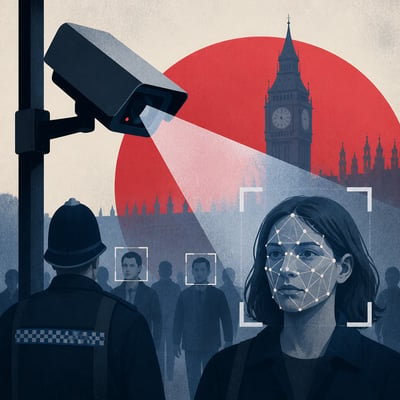
Live facial recognition is expanding across UK police operations, retail stores and selected public locations, while Delhi Police has also used facial matching around a protest site. Authorities and retailers present the systems as targeted tools for identifying wanted or repeat offenders, but civil-liberties groups and legal challengers question their accuracy, transparency, proportionality, potential racial bias and independent oversight. The central tension is whether operational benefits justify scanning people in public spaces and extending biometric surveillance into private-sector settings.
First Article: 01/30/26
Latest Article: 07/25/26
History
The story now includes a more specific Delhi Police use case and a tighter emphasis on implementation details, but the core controversy remains the same: expanding biometric surveillance is outpacing oversight. The main shift is clarification of how and where live facial recognition is being operationalized, rather than a fundamentally new direction.
The story has broadened from police live facial recognition to include private retail deployments, with Facewatch planning real-time police alerts across more than 100 UK businesses. At the same time, the legal and oversight picture has sharpened: a High Court challenge was dismissed, but concerns over false matches, discrimination and weak redress remain unresolved.
- Facewatch will send real-time police alerts from more than 100 UK retailers.
- A High Court challenge to Metropolitan Police policy was dismissed.
- Reported arrest, false alert and match figures now vary across sources.
- Information on complaints and downstream case outcomes remains incomplete.
- Delhi Police used facial recognition around a protest site.
The story has broadened from mostly UK police and retail trials into a wider public-sector surveillance debate, with live facial recognition now described as operating across transport hubs, streets, ports, protests, and border checks. Delhi Police’s protest deployments and the added focus on immigration and border enforcement make the governance and civil-liberties stakes more urgent and more international.
- British Transport Police and Thames Valley Police are now named users.
- UK Home Office is part of the current policy context.
- Delhi Police deployments at protests are newly included.
- Border-check and immigration use is explicitly mentioned.
- Local oversight structures are now highlighted as part of regulation.
The biggest change is that the story now frames retail facial recognition as moving closer to operational police integration, with Facewatch planning real-time alerts, while oversight concerns sharpen around whether private deployments have equivalent safeguards. The evidence base also shifts from general criticism to more specific references to demographic-bias findings and complaint-handling weaknesses.
The story now emphasizes a broader, more operational rollout of live facial recognition, including officer-initiated use and retail-to-police alerting, while adding a concrete false-alert example and clearer evidence that oversight remains unsettled. The legal position also looks more settled for current Met use after the High Court loss, even as objections continue.
- Croydon pilot produced one reported false alert among 470,000 passersby.
- 100 officers are piloting roaming facial-recognition devices during stops or checks.
- Facewatch will alert police in real time on serious-offender matches.
- Essex paused deployments and ordered a software review after performance concerns.
- High Court challenge to the Met policy failed.
The story now adds concrete operational details: the Met is moving from pilots to a planned officer-operated rollout, while Essex has paused deployments after a study flagged fairness concerns. At the same time, the retail angle is sharpened by Facewatch’s real-time police alert plans and a High Court ruling that leaves broader discrimination and proportionality questions unresolved.
- Met Police plans a six-month pilot for 100 officers with roaming or handheld facial recognition.
- Essex Police paused live deployments after Cambridge study findings.
- Facewatch is used by more than 100 UK businesses and plans real-time police alerts.
- High Court rejected a human-rights challenge to the Met’s policy.
The story has broadened from police use of live facial recognition into a wider UK-wide deployment pattern that now includes border enforcement and retail, while the core debate shifts toward whether oversight and consent rules can keep up. The new framing is less about isolated police trials and more about an operational rollout across multiple sectors.
- Retail facial recognition is now part of the story.
- Facewatch is preparing real-time police alerts from store matches.
- Thames Valley Police is using live facial recognition vans.
- Border and immigration enforcement at Holyhead is a new deployment setting.
- Deployments are described as live or imminent in 2026.
The story has broadened from general police-facing rollout to a clearer picture of routine operational use, with border and port deployments now more prominent. At the same time, legal and oversight scrutiny has sharpened as a parallel track to the expansion.
UK police and immigration agencies are expanding live facial recognition across stations, streets, and border settings, while regulators, courts, and civil liberties groups continue to debate accuracy, discrimination, and limits on biometric data use.