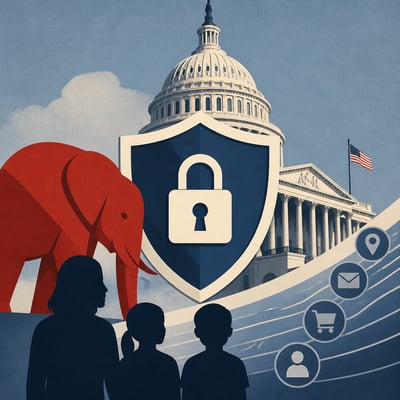
The Record / Suzanne Smalley04-23-2026
House Republicans introduced the SECURE Data Act on federal privacy and FTC data broker registry requirements, but privacy advocates warned exemptions and preemption weaken consumer protections.
 IAPP.org04-22-2026
House Energy and Commerce Republicans introduced the SECURE Data Act draft in the USA to create a federal privacy standard that preempts state laws.
 Bloomberg Law05-22-2026
Rep. John Joyce introduced the SECURE Data Act to create a preemptive federal privacy baseline enforced by the FTC and state attorneys general, with defined business and data broker thresholds.
 Nextgov / Chris Teale04-29-2026
House Republican committees unveiled the SECURE Data Act to create a federal privacy standard enforced by the FTC while preempting state privacy laws.
 CyberScoop04-22-2026
House Republicans introduced the Secure Data Act in the U.S. Congress to expand opt-out privacy rights and FTC and state enforcement, drawing opposition over preemption and limited remedies.
IAPP / Alex LaCasse05-29-2026 Future of Privacy Forum and CalPrivacy stakeholders debated the SECURE Data Act on June 3 hearing timing, centering disagreements on federal preemption, opt-out signals, dark patterns, data broker deletion, and enforcement.
 Legis106-03-2026
House Energy and Commerce will hold a June 3 hearing on H.R. 8413 SECURE Data Act, proposing a preemptive federal privacy framework amid large breach events.
 Mondaq / Lynn Parker Dupree06-22-2026
House Energy and Commerce Committee Privacy Working Group introduced SECURE Data Act on April 22, 2026 to create a preemptive federal consumer privacy framework.
 JD Supra04-24-2026
Rep. John Joyce introduced the SECURE Data Act on April 22, 2026, proposing FTC and state enforcement of national consumer privacy rights with broad preemption over state laws.
JD Supra05-01-2026 Congress introduces the SECURE Data Act to create a federal consumer privacy standard with FTC and state attorney general enforcement and a national data broker registry.
JD Supra05-06-2026 House Energy and Commerce Committee released the SECURE Data Act on April 22, 2026, proposing federal consumer privacy rights, opt-out rules, and state-law preemption.
JD Supra05-08-2026 On 21 April 2026, House Republicans introduced the SECURE Data Act (H.R. 8413) to create a national U.S. privacy standard with consumer rights and FTC-led enforcement.
JD Supra05-11-2026 House Republicans introduced H.R. 8413 SECURE Data Act in April 2026 to create a national consumer privacy standard, FTC data broker registry, and opt-in consent rules.
JD Supra06-01-2026 John Joyce introduced the SECURE Data Act on April 21, 2026 to create federal consumer privacy rights enforced by the FTC and state attorneys general.
 Alston & Bird Privacy / Jennifer Everett04-29-2026
House lawmakers introduced the SECURE Data Act on April 21, 2026 to standardize U.S. consumer privacy rights and enforcement after a 45-day cure period.
 National Law Review05-12-2026
Guthrie and Joyce introduced HR 8413 on April 22, 2026 to create a federal consumer privacy standard enforced by the FTC and state attorneys general.
 DiCello Levitt / Adam Levitt and Amy Keller05-06-2026
Congress introduced the SECURE Data Act in the U.S., while recent jury verdicts against Google LLC and Meta Platforms Inc. highlighted app tracking and sensitive data collection concerns.
 Finnegan / Lynn Parker Dupree06-16-2026
House Energy and Commerce Committee privacy working group introduced the SECURE Data Act on April 22, 2026, proposing a uniform national privacy standard that preempts state laws.
 Kronenberger Rosenfeld / Liana Chen06-29-2026
The SECURE Data Act H.R. 8413 was introduced in April 2026 to create nationwide consumer privacy rights, sensitive-data opt-in consent, and FTC-managed data-broker registration while preempting many overlapping state privacy laws.
 Clark Hill04-22-2026
On April 22, 2026, the House Energy and Commerce Committee announced the SECURE Data Act, a federal privacy proposal with broad individual rights and FTC-led enforcement.
JDSupra06-18-2026 June 3, 2026 House hearing reviewed the SECURE Data Act, a proposed federal privacy law featuring state-law preemption and FTC-led data broker registration.
 EFF / Mario Trujillo05-06-2026
EFF criticized the proposed SECURE Data Act in 202x for broad federal preemption, weak privacy defaults, and lack of a private right of action, limiting consumer enforcement.
 Gblock06-25-2026
In June 2026, US Congress considered SECURE Data Act (HR 8413) and S.4211, which would create federal consumer privacy rights and preempt stronger state rules.
 Brookings / Cameron F. Kerry04-23-2026
House Energy and Commerce released the SECURE Data Act discussion draft in the United States, proposing FTC and state AG enforcement, broad state preemption, and no private right of action.
 AdExchanger / Allison Schiff04-24-2026
U.S. House Republicans introduced the SECURE Data Act in 2026 to create an FTC-enforced national privacy standard that preempts state laws for covered companies.
 Privacy and Data Security Insights / Kennedy Brooks04-28-2026
House committees announced SECURE Data Act and GUARD Financial Data Act to strengthen federal consumer privacy rights, consent, and enforcement for personal and financial data.
 AEI / Shane Tews05-01-2026
The House Energy and Commerce Committee Privacy Working Group introduced the Secure Data Act on April 22 to create FTC-enforced federal privacy duties addressing data collection and consumer rights in the United States.
 Tech Policy Press / Eric Null04-23-2026
The SECURE Data Act draft faces criticism in the United States for lacking civil rights protections, omitting private enforcement rights, and imposing broad preemption on state privacy laws.
 Epstein Becker & Green05-12-2026
Guthrie and Joyce introduced HR 8413 on April 22, 2026, proposing FTC and state enforcement of federal consumer privacy rights and obligations in the U.S.
 mePrism / Tom Daly07-17-2026
On June 3, 2026, H.R. 8413 supporters backed the SECURE Data Act, a federal privacy preemption bill introduced by Rep. John Joyce.
 Third Way06-03-2026
SECURE Data Act proponents argue for federal U.S. privacy rights, sensitive-data permission requirements, and a data broker registry while urging stronger enforcement and narrower preemption.

 Climate
 Privacy
 Bob Dylan
 Drones
 Data Centers
 AI Governance
 2026 Maine Senate Race