
 Climate
 Privacy
 Bob Dylan
 Drones
 Data Centers
 AI Governance
 2026 Maine Senate Race
Solar Farms Add Cattle Grazing
Coverage from Electrek, Insurance Journal, and others
Articles
11
Active Days
59
The Topic
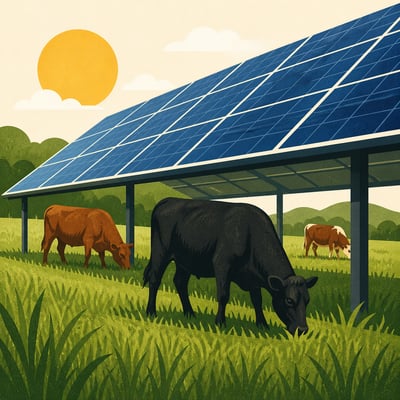
Solar developers are testing whether agricultural land can support both utility-scale electricity generation and livestock production. Silicon Ranch's 40-acre Christiana Solar Ranch in Tennessee uses slightly raised panels and software-controlled positioning to accommodate cattle while supplying roughly 5 megawatts to Middle Tennessee Electric; sheep grazing is also expanding at other U.S. solar sites. The approach could reduce conflict over solar development on farmland and provide farmers with additional lease or grazing income, but cattle-specific designs, economics, animal welfare, and long-term agricultural outcomes still require broader validation.
First Article: 04/30/26
Latest Article: 06/27/26
Summary
- Silicon Ranch launched a 40-acre cattle-grazing solar demonstration in Christiana, Tennessee.
- Software shifts panels closer to horizontal over occupied paddocks, creating space for cattle while other sections continue generating electricity.
- The Tennessee site currently supports about 10 cows and calves and targets roughly 5 megawatts for Middle Tennessee Electric.
- Researchers and project participants report potential improvements in pasture moisture, drought tolerance, and cattle heat exposure, but these findings remain tied to an early-stage demonstration.
- Sheep grazing is already being used at solar sites in Illinois and across the United States to manage vegetation and reduce mechanical mowing.
- Agrivoltaics may help farmers diversify income and address opposition to converting productive farmland, though higher design and operating costs can limit expansion.
- Scaling cattle grazing will require repeatable site designs, equipment protection, suitable fencing and wire management, and workable incentives for ranchers.
History
The story has sharpened from a general agrivoltaics trend into a concrete, named cattle-grazing demonstration in Tennessee, with clearer operational details and a more explicit focus on scalability constraints. It also adds stronger evidence that sheep grazing is already established more broadly, while cattle-specific deployment remains unproven.
The story has broadened from a Tennessee cattle-grazing solar pilot to a clearer multi-state implementation picture, with Illinois adding a second operating model and the framing shifting toward practical deployment constraints. Agrivoltaics is now presented less as a niche concept and more as an early-stage land-use strategy with real siting, equipment, and farm-income considerations.
Featured
Timeline: 59 Days
Hover over any logo to see coverage summary, click for full article.