
 Climate
 Privacy
 Bob Dylan
 Drones
 Data Centers
 AI Governance
 2026 Maine Senate Race
Solar Farms Share Land With Nature
Coverage from Vermont Public, BGR, and others
Articles
5
Active Days
109
The Topic
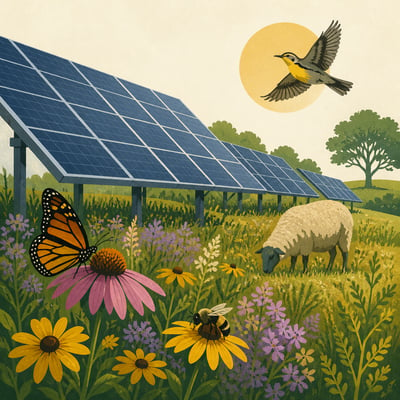
Solar farms are increasingly being evaluated not only as power facilities but also as managed landscapes that can support pollinators, birds, native vegetation, and livestock. Evidence from Vermont, Spain, the United Kingdom, and research institutions suggests that benefits are most likely when projects use degraded land, protect habitat, limit chemical inputs, and incorporate grazing or other agricultural uses. At the same time, large projects continue to raise concerns about farmland conversion, drainage, construction impacts, local control, and enforceable restoration requirements.
First Article: 04/08/26
Latest Article: 07/25/26
Summary
- Solar sites on degraded or intensively farmed land may provide habitat for pollinators, birds, insects, and small mammals when native vegetation is restored.
- Sheep grazing is being used in Vermont and elsewhere to manage vegetation while supporting farm income and maintaining agricultural use.
- Studies and field surveys report higher bird or insect abundance at some biodiversity-managed solar sites than on nearby intensive farmland.
- Habitat outcomes depend on siting, vegetation management, chemical use, hedgerows, water protection, and ecological connectivity rather than panel installation alone.
- Utility-scale projects can require substantial acreage and create concerns about farmland, drainage, landscape change, construction disruption, and property values.
- Decommissioning and land restoration remain governance issues because outcomes depend on enforceable requirements and adequate financial backing.
History
The story is now more explicitly about solar farms as multi-use landscapes, with livestock grazing and crop production added alongside habitat goals. The updated version also sharpens the conditions for success, emphasizing chemical limits, water protection, and connectivity rather than panel installation alone.
The story has broadened from a largely conceptual discussion of wildlife-friendly solar on degraded land into a more specific, evidence-backed account of how solar sites can function as managed landscapes for grazing, habitat, and biodiversity. It also now places greater emphasis on concrete project examples and on the continuing risks of siting projects on healthy ecosystems.
Featured
Timeline: 109 Days
Hover over any logo to see coverage summary, click for full article.