
Last Update: 06/03/2026 at 6:25 AM EST
Alberta Carbon Capture Expansion
Coverage from The Energy Mix, Financial Post, and others
Articles
16
Latest Article
06/01
Active Days
216
Executive Summary
Alberta and federal officials are advancing carbon capture and storage through pricing deals, incentives, and large oil sands-linked infrastructure plans, while Indigenous, rural, and advocacy critics question costs, safety, and effectiveness.
Key Points
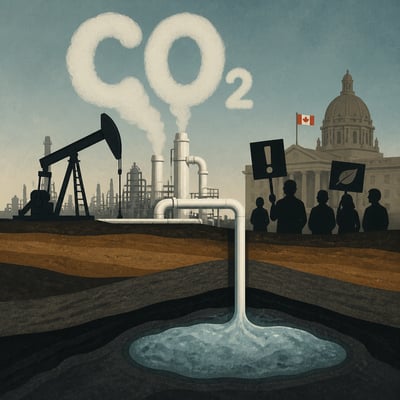
- Recent government action ties higher industrial carbon prices to CCS investment and long-term emissions-reduction planning in Alberta.
- The Pathways Alliance project remains the main infrastructure anchor, with proposed CO2 pipelines and underground storage near Cold Lake and northern Alberta.
- Federal and provincial support is framed as a way to keep oil sands production competitive while reducing emissions intensity.
- Opposition is growing around consultation, environmental review, groundwater risk, pipeline safety, and the chance of cost overruns.
- Several items stress that CCS performance is uncertain, with limited cost data, implementation delays, and concerns about whether projects will meet stated capture targets.
- The debate is split between CCS as a necessary industrial transition tool and CCS as an expensive subsidy that delays cleaner alternatives.
Featured Article
Canada announced July 2025 funding for CCUS projects, including Bow Valley Carbon in Alberta, as Alberta expands incentives and regulation amid debates over cost and environmental risks.
Coverage Timeline: 216 Days
Hover over any logo to see coverage summary, click for full article.
Additional Articles
⭐⭐⭐⭐⭐
Canada's federal government supports a 16.5 billion carbon capture and storage project in Alberta tied to a west coast pipeline, announced in Budget 2025.
Climate scientists Myles Allen and Andrew Weaver propose in a Canada-focused analysis that governments mandate and internalize full carbon disposal costs to deliver verifiable net-zero fossil fuels.
In Alberta in 2025–2026, the provincial government and Pathways Alliance are accelerating CCS investment through hub infrastructure, cost-shared pipelines, and enhanced TIER carbon pricing incentives.
Alberta issued a draft CCUS quantification protocol update on May 27, 2026, expanding storage eligibility and MRV rules for Removal Credits and permanence.
Prime Minister Mark Carney and Premier Danielle Smith announced a Canada-Alberta agreement increasing industrial carbon pricing and financing CCS deployment from 2030 to 2040.
⭐⭐⭐
Mark Carney's federal government and Alberta reached industrial carbon pricing terms to enable the Pathways oil sands CCS project and related pipeline approvals by September 2027.
Ottawa and Alberta carbon pricing talks for industrial decarbonization and CCS exceeded deadlines as the Pathways carbon capture network and West Coast pipeline plan await regulatory and financial support.
Chief Allan Adam and Amil Shapka urge Alberta and Ottawa to abandon Pathways Plus CCS, citing CO2 pipeline safety, emergency response concerns, and uncertain emissions capture in northern Alberta.
Prime Minister Mark Carney and Premier Danielle Smith signed a Calgary agreement with the Oil Sands Alliance in support of Pathways CCS negotiations in Alberta.
No CO2 Pipeline coalition in Alberta urges federal action on environmental impact assessment for a proposed Pathways Alliance CO2 pipeline CCS project, citing inadequate consultation and rupture and contamination risks.
In Edmonton, a coalition of Indigenous leaders and rural Albertans asked Ottawa for a federal environmental review of Alberta's Pathways CCS pipeline after Alberta waived an impact assessment in 2024.
Canada and Alberta agreed on a net-zero implementation package in Alberta, reforming TIER carbon pricing, expanding electricity transmission, and linking CCUS with low-emission bitumen exports.
⭐️⭐️
Canada and Alberta push carbon capture in oil sands and plan higher carbon pricing by April.
Industry, policymakers, and researchers evaluate CCS viability in 2024 globally as renewables become cheaper.
Food and Water Watch reports CCS failures in the United States amid Google Decatur project activity.