
Last Update: 08/01/2026 at 2:00 PM EST

California Batteries Expand Amid Grid Pressures

Coverage from Inside Climate News, Utility Dive, and others

Articles

19

Active Days

109

The Topic
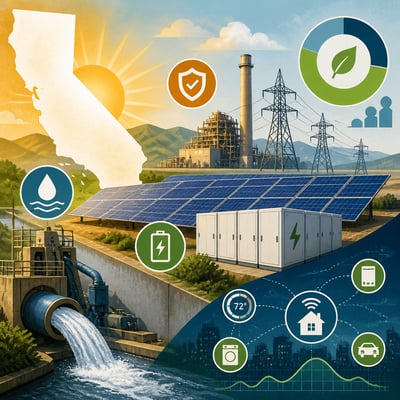
California Batteries Expand Amid Grid Pressures topic image

California is expanding battery storage, virtual power plants, and renewable power to reduce reliance on natural gas and support growing electricity demand. Batteries supplied about 40% of evening demand during a late-March event, while distributed resources are being used to provide additional grid capacity. Progress is accompanied by funding uncertainty, high system costs, permitting and transmission constraints, climate-related stresses, and disagreement over how demand-response programs should be administered.

First Article: 04/06/26

Latest Article: 07/23/26

Summary

  • California batteries supplied roughly 40% of evening demand during a late-March event, highlighting storage’s growing role in reliability.
  • The state’s Demand-Side Grid Support program aggregates more than 200,000 households and has produced more than 1 GW of capacity during periods of grid stress.
  • Proposed funding changes could move customers from the California Energy Commission’s demand-response program to a utility-administered alternative after 2026.
  • Electrification, heat pumps, electric vehicles, and possible data-center growth are expected to increase demand through 2035.
  • The 105-MW Pastoria Solar Project, paired with a 320-MWh battery system and existing gas generation, will help decarbonize State Water Project operations while preserving reliability.
  • Climate impacts, aging equipment, permitting delays, transmission needs, and local opposition continue to pressure California’s power system.

History

07/22/2026

The main update is a sharper emphasis on California’s expanding use of demand-side resources: the story now highlights measurable late-March battery performance and a much larger, more explicit role for the Demand-Side Grid Support program. It also reframes the policy fight around a possible shift from the CEC program to a utility-run alternative after 2026.

07/22/2026

The story is largely unchanged, but it now frames California’s clean-energy buildout more explicitly around rising demand pressures and the execution risk around funding and integrating virtual power plants. The updated version slightly downplays the earlier emphasis on climate-driven reliability threats and shifts the focus toward affordability, permitting, and infrastructure constraints.

Full History

Featured

Timeline: 109 Days

Apr 6Apr 27May 18Jun 8Jun 29Jul 20

Additional Articles

⭐⭐⭐⭐⭐

Los Angeles Times04-20-2026
Kern County, California, officials announced a 105-megawatt Pastoria solar deal by DWR to help power State Water Project pumps as California targets carbon-neutral operations by 2035.
E3 / Tali Perelman04-23-2026
At San Francisco Climate Week, E3 panelists discussed California power-sector decarbonization solutions focused on permitting, grid equipment procurement, and resilient solar and battery storage.
AutoNotion / Luis Reyes06-27-2026
California’s Project Nexus completed a canal-top solar pilot in the Turlock Irrigation District, reporting 50% to 70% evaporation reduction after one season.
Climate Community Institute / Batul Hassan and Kira McDonald06-04-2026
Assemblymember Petrie-Norris introduced the California Grid Manufacturing Initiative in February 2026 to cut grid equipment costs and delays hindering renewable and storage deployment.
Heatmap07-07-2026
Governors from 11 Western states agreed to expand regional transmission as FERC rejected an interconnection waiver for a major gas project and other energy developments progressed across several countries.

⭐⭐⭐

Los Angeles Times05-14-2026
California’s Demand-Side Grid Management program could lose state funding after 2026 as Governor Gavin Newsom proposes shifting participants to a CPUC program.
Ceres Courier05-20-2026
Turlock Irrigation District, with UC Merced and California officials, advances Project Nexus solar canal coverings in Stanislaus County to reduce evaporation and algae while generating clean electricity.
California State Senate05-28-2026
California passed SB 913 to let customer-owned batteries, electric vehicles, and smart thermostats compete in resource adequacy and provide least-cost reliability.
California Energy Commission05-05-2026
California energy agencies project improved summer 2026 grid reliability, citing battery storage expansion, contingency reserves, and the California ISO Extended Day-Ahead Market launched May 1.
Mercury News / Blanca Begert and Ian James07-23-2026
California Central Valley groundwater limits are pushing growers to convert farmland to large solar-plus-storage projects through 2040s clean-electricity planning.
California Public Utilities Commission07-10-2026
CPUC-led California storage policy expands battery deployment and refocuses storage dispatch to support renewable energy and peak-demand reliability.
Canary Media06-08-2026
Canary Media organized rural clean energy discussions at Climate Week NYC as battery, nuclear microreactor, transmission, and utility rate issues advanced in several U.S. states.
CleanEnergy.ca04-17-2026
California Energy Commission updates California's Clean Energy Journey with renewable progress, efficiency savings, and equity and tribal grant funding toward 100% clean electricity by 2045.
Climate and Community Institute04-06-2026
Climate and Community Institute supports a California Grid Manufacturing Initiative introduced in California by Assemblymember Petrie-Norris to address transformer supply shortages.
Politico04-16-2026
Scott Wiener advanced California Senate Bill 1097 on CEQA exemptions for transmission upgrades after opposition from environmental groups.
Californiaglobe / Garvin Walsh04-28-2026
San Diego Gas & Electric customers face higher electricity bills as California climate mandates, reliability backup requirements, and rate-base cost recovery expand mandated charges.