History
07/22/20260 new articles
The main update is a sharper emphasis on California’s expanding use of demand-side resources: the story now highlights measurable late-March battery performance and a much larger, more explicit role for the Demand-Side Grid Support program. It also reframes the policy fight around a possible shift from the CEC program to a utility-run alternative after 2026.
07/22/20260 new articles
The story is largely unchanged, but it now frames California’s clean-energy buildout more explicitly around rising demand pressures and the execution risk around funding and integrating virtual power plants. The updated version slightly downplays the earlier emphasis on climate-driven reliability threats and shifts the focus toward affordability, permitting, and infrastructure constraints.
07/22/20262 new articles
The story has shifted from a broad clean-power buildout and grid-resilience challenge to a more specific policy fight over how California will fund, govern, and scale flexible resources like virtual power plants. Affordability and federal tax-credit uncertainty now sit alongside transmission and permitting as the key constraints.
- 200,000+ households are enrolled in demand-response programs.
- DSGS may be ended after 2026 under proposed funding changes.
- Pastoria Solar is paired with an 80 MW/320 MWh battery.
- Affordability concerns are now central to clean-energy expansion.
- Load growth now includes water pumping and data centers.
06/29/20260 new articles
The story now emphasizes California’s clean-grid transition as a broader systems challenge: not just deploying renewables, but accommodating much faster load growth, climate stress, and supply-chain constraints. Battery storage remains central, but the main update is the shift toward a more complex resilience-and-infrastructure buildout, including centralized procurement and alternative solar siting models.
- California recently discharged more than 12 GW from grid-connected batteries.
- Electrification and data centers are expected to drive substantial load growth.
- Federal clean-energy tax credit changes now pose project-risk for late-completing projects.
- Climate stress now includes flooding and sea-level rise, not just heat and wildfire.
- Centralized procurement for transformers is now part of the grid-buildout response.
06/28/20263 new articles
The story has shifted from a broad reliability-and-permitting narrative to one that emphasizes concrete implementation constraints: selective CEQA reform, grid equipment shortages, and funding uncertainty are now the main blockers to scaling clean power. The current version also adds more explicit evidence of operational progress, with summer reliability improving even as climate stress and costs remain high.
05/29/20263 new articles
The story has shifted from a general clean-power transition narrative to a more operational one centered on how California will actually keep the grid reliable under rising demand. The new emphasis is on batteries and customer devices as active grid resources, alongside stronger framing of permitting reform, funding uncertainty, and centralized-versus-distributed reliability debates.
05/19/20261 new articles
The story has shifted from a general clean-power implementation challenge to a more specific push for concrete deployment fixes, including permitting reform, CEQA changes, and expanded demand-side resources. It also now places greater emphasis on rates, cost recovery, and program governance as central constraints alongside reliability.
05/11/2026Topic Formed
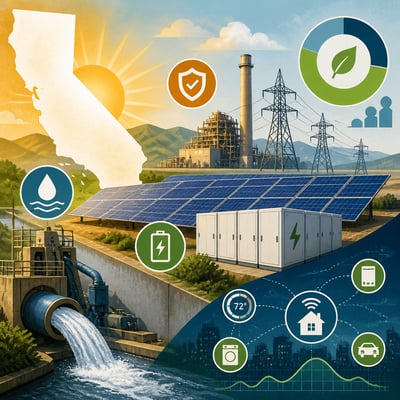
The cluster is centered on California’s clean-power transition as a grid-reliability and implementation problem: battery storage is scaling quickly, but permitting, transmission, equipment supply, and rate impacts remain the main constraints. Coverage also shows California agencies and advocates framing decarbonization around heat, wildfire, flooding, and load growth from electrification and data centers. The current state is an active policy-and-infrastructure phase, with some evidence of improved summer reliability alongside continuing disputes over cost, CEQA, and the pace of buildout.

 Climate
 Privacy
 Bob Dylan
 Drones
 Data Centers
 AI Governance
 2026 Maine Senate Race