
California Marine Heat And Ecosystem Risk
Coverage from The Guardian, Los Angeles Times, and others
Articles
8
Latest Article
04/16
Active Days
1338
Executive Summary
Recent material consistently shows marine heatwaves and persistent ocean warming affecting California and comparable marine regions, with measurable impacts on fish distributions, kelp ecosystems, whale entanglement risk, and coastal hazard exposure. The strongest current signal is operational and scientific: researchers and agencies are tracking heat-driven changes more closely and testing management responses, while broader studies link chronic ocean warming to declining marine biomass and enclosed seas to rising heat stress. The topic is coherent and fairly dense, with most evidence pointing to an ongoing structural climate-driven marine risk pattern rather than a short-lived event.
Key Points
- Persistent marine heatwaves off California are breaking temperature records and suppressing the usual cold-water upwelling that sustains coastal marine food webs.
- Multiple studies connect warm-ocean conditions to ecosystem disruption, including kelp loss, fish biomass declines, harmful algal bloom risk, and shifting species distributions.
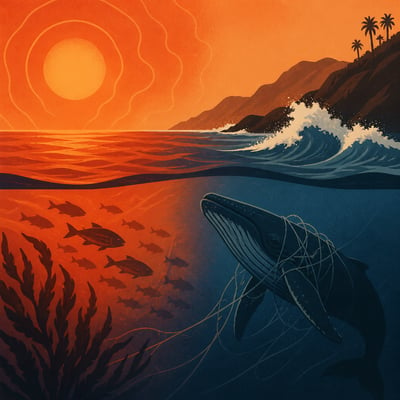
- Climate-driven heat compression is increasing humpback whale entanglement risk near shore, prompting NOAA and state agencies to test gear reductions and ropeless fishing tools.
- Ocean warming is not just a surface event: chronic seabed heating is linked to long-term biomass losses even when short heat spikes temporarily mask decline.
- Warm ocean conditions are also being tied to hurricane intensification and higher coastal disaster damage, extending the relevance beyond the California coast.
- Enclosed seas such as the Mediterranean, Baltic, and Gulf of Mexico appear especially exposed because limited water exchange allows heat to accumulate quickly.
- Management responses are increasingly data-driven, using monitoring systems, heat indices, and fishery observations to detect change and guide adaptation.
Featured Article
Coverage Timeline: 1338 Days
Hover over any logo to see coverage summary, click for full article.