
Last Update: 06/03/2026 at 5:25 AM EST

Climate-Driven Ecosystem And Food Risks

Coverage from Climate Central, Yale Climate Connections, and others

Articles

13

Latest Article

05/19

Active Days

135

Executive Summary

Climate change is driving visible disruptions across ecosystems, forests, and food systems. The strongest signal is shifting species timing, expanding wildfire and forest disturbance risk, and mounting pressure on agriculture and seasonal reliability. Evidence spans observational studies, regional analyses, and model-based projections, with adaptation increasingly framed around drainage, crop diversification, water management, and ecosystem resilience. The topic is coherent and fairly dense, with most material reinforcing the same set of climate-impact pathways rather than introducing separate narratives.
Climate-Driven Ecosystem And Food Risks topic image

Key Points

  • Species timing is shifting earlier or becoming less predictable, creating mismatches between plants, pollinators, birds, and migratory wildlife.
  • Forest disturbance risk is rising through drought, pests, windthrow, and wildfire, with several studies pointing to threshold behavior and long-term ecosystem change.
  • Food systems are showing climate exposure through crop losses, altered growing seasons, import dependence, and transport disruption.
  • Regional case studies from the UK, India, and the U.S. show the same basic pattern: heat, floods, rainfall volatility, and pests are reducing agricultural reliability.
  • Wildfire projections and forest studies suggest biodiversity losses could intensify under higher warming, while stronger mitigation reduces the projected damage.
  • Adaptation responses repeatedly emphasize drainage, irrigation efficiency, drought-tolerant crops, diversified farming, corridor-based conservation, and early warning systems.
  • Much of the evidence is forward-looking but grounded in observed change, making the cluster a mix of measured impacts and model-based risk projection.

Featured Article

BusinessGreen01-05-2026
Researchers report temperature linked phenology shifts affecting biodiversity and food security across diverse regions.

Coverage Timeline: 135 Days

Jan 5Feb 2Mar 2Mar 16Apr 13May 11

Additional Articles

⭐⭐⭐⭐⭐

Yale Climate Connections / Sanket Jain05-18-2026
Farmers in Jambhali, western India, report crop losses as climate change increases monsoon variability, making seasonal forecast reliability and pest impacts less predictable.
Earth.Org / Claudia De Luca05-19-2026
Warming is shifting species ranges and migration timing across the Arctic and South Asia, raising biodiversity and food security risks and prompting calls for assisted migration and dynamic conservation.
Scienmag04-06-2026
University of Gothenburg researchers project climate-driven wildfire increases that raise IUCN-listed species vulnerability by the end of the century, with strongest effects in South America, South Asia, and Australia.
Frontiers in Climate05-18-2026
From 1996 to 2025, studies using trend tests find warming, humidity changes, and weaker monsoon rainfall across India tea regions, increasing cultivation risk.
Nature Index05-15-2026
Global change biology and landscape ecology research indicates climate change and herbivory can push European forests past thresholds with hysteresis and reduced resilience.
Aithor03-27-2026
Human greenhouse gas emissions are changing terrestrial and marine ecosystems via phenology, carbon cycle feedbacks, ocean warming and acidification, and non-linear tipping risks.

⭐⭐⭐

Climate Central04-08-2026
Climate change is shifting migration timing and northward ranges of North American birds, contributing to large population declines and heightened vulnerability under near-term warming by 2100.
Inside Climate News / Kiley Price04-07-2026
Research discussed by Bob Berwyn links climate warming to expanding European forest disturbances and North American pest-driven tree loss, with projected century-end ecosystem changes.
Emagazine.com / Peter O'Rourke04-14-2026
Rising climate-driven extremes increase ecological and community risks, requiring equitable adaptation planning through infrastructure upgrades, stronger building codes, early warnings, and nature-based solutions.
Energy Live News / Sumit Bose02-05-2026
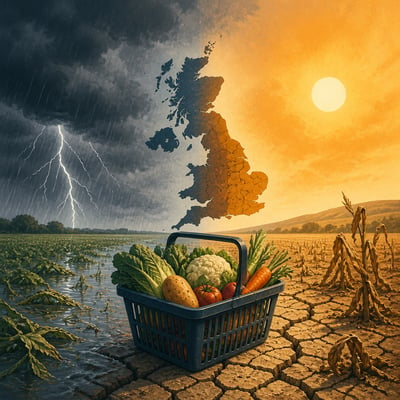
UK researchers warn climate driven extremes threaten the UK food supply in 2024 and beyond.
WFMZ-TV 69 News / Bella Bucchiotti03-25-2026
NOAA data and Climate Central analysis report human-caused warming in most major U.S. cities is shifting spring timing, affecting corn yields and farmers market food availability.

⭐️⭐️

Encyclopedia Britannica / Michael E. Mann01-28-2026
Global warming drives ecosystem disruption and biodiversity loss worldwide as temperatures rise today.