
 Climate
 Privacy
 Bob Dylan
 Drones
 Data Centers
 AI Governance
 2026 Maine Senate Race
Canadian Coastal Marine Risk
Coverage from Earth.Org, Phys.org, and others
Articles
4
Active Days
72
The Topic
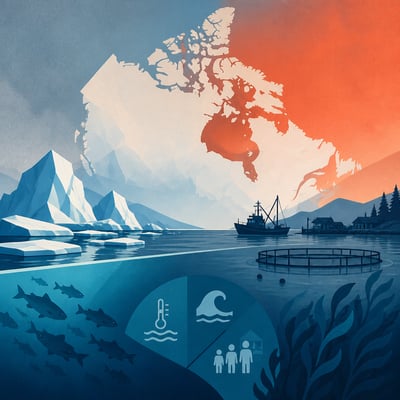
Recent research warns that climate change could sharply alter Canada’s marine ecosystems, with major risks to fisheries, aquaculture, ecotourism, coastal livelihoods, and Indigenous food security. The strongest projected losses are in the Arctic, while adaptation planning is being tied to Canada’s Blue Economy Strategy.
First Article: 03/31/26
Latest Article: 06/10/26
Summary
- New research projects major climate-driven changes in Canada’s marine resources, with some regions facing steep declines under high-emissions conditions.
- The most exposed sectors are fisheries, aquaculture, ecotourism, and other coastal activities that depend on stable marine ecosystems.
- The Arctic stands out as the highest-risk region, with additional losses expected in parts of the Pacific and Atlantic coasts.
- Indigenous communities are identified as especially vulnerable because of their reliance on marine resources for livelihoods and food security.
- The policy response is moving toward adaptive, inclusive climate-resilient planning alongside Canada’s Blue Economy Strategy.
- The signal is fairly coherent and current, but it is based on a narrow evidence set that is mostly forward-looking rather than event-driven.
History
The story has been reframed slightly to emphasize Indigenous food security and policy planning, but the underlying climate-risk assessment for Canada’s marine sectors remains essentially the same. The main new emphasis is on aligning adaptation with Canada’s Blue Economy Strategy.
Featured
Timeline: 72 Days
Hover over any logo to see coverage summary, click for full article.