
Last Update: 08/01/2026 at 12:00 PM EST

Climate Impacts On Ecosystems And Food Systems

Coverage from Carbon Brief, The Guardian, and others

Articles

29

Active Days

201

The Topic
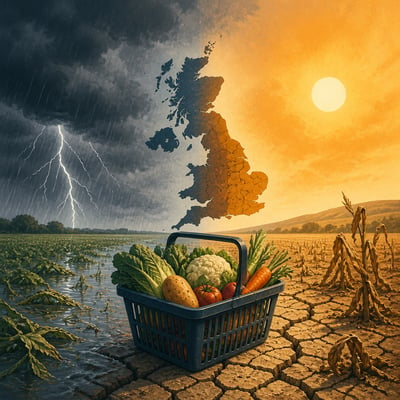
Climate Impacts On Ecosystems And Food Systems topic image

Recent coverage links warming to shifting plant and animal timing, more damaging extremes, and rising pressure on farms, forests, and biodiversity. The strongest signal is operational: climate stress is changing growing seasons, disturbance regimes, and local adaptation needs across multiple regions. Research and reporting converge on the same broad pattern, but the material is spread across ecosystems and geographies rather than one single policy or event. The topic looks structurally ongoing, evidence-dense, and fairly coherent, with uncertainty concentrated in regional differences, long-range projections, and the pace of adaptation.

First Article: 01/05/26

Latest Article: 07/24/26

Summary

  • Plant and animal timing is shifting earlier or later under warming and extreme weather, increasing mismatch risks between species and seasons.
  • Food production is showing climate stress through altered spring timing, crop losses, import exposure, and weaker reliability of seasonal cues.
  • Wildfire and forest disturbance remain major themes, with warming-linked fire risk, pest outbreaks, drought stress, and carbon loss affecting ecosystems.
  • Several articles emphasize adaptation rather than only impact, especially crop diversification, drainage, water management, grazing controls, and habitat management.
  • Regional signal is strong in India, the UK, and parts of the U.S., but the direction and intensity of effects vary by place and ecosystem.
  • Many claims rely on modeling or trend analysis, while a smaller share reflects direct field observation or survey data.
  • The topic is coherent as a climate-impacts cluster, but it is internally broad and fragmented across biodiversity, agriculture, and disaster risk.

History

07/20/2026

The framing has shifted from a broad catalogue of climate impacts to a more operational story about how warming is changing seasonal timing, disturbance regimes, and adaptation needs across food systems and ecosystems. The update also adds clearer regional emphasis and a stronger split between modeled/trend-based evidence and direct observation.

07/01/2026

The story has become more specifically framed around UK food security, bird conservation, and operational adaptation, rather than broad climate impacts across many ecosystems. It also adds new named actors and sharper emphasis on systemic resilience in supply chains and infrastructure.

Full History

Featured

Timeline: 201 Days

Jan 5Feb 16Mar 30Apr 27Jun 8Jul 20

Additional Articles

⭐⭐⭐⭐⭐

EurekAlert!07-08-2026
Cornell University researchers report that northern U.S. and Canada tree swallows face higher reproductive risk as warming advances breeding while pre-breeding temperature variability reduces the margin for responding effectively.
The Independent / Emily Beament07-09-2026
RSPB monitoring in the UK during 2025 found mountain dotterel breeding males fell to an estimated 112 total, with no breeding in England or Wales.
Phys.org / Delphine Paysant and Julien Mivielle06-19-2026
A March Nature Ecology and Evolution study linked climate-amplified heat waves to biodiversity harm during a 2021 western North America extreme heat event.
Frontiers06-05-2026
Editorial synthesizes studies linking warming and urbanization to avian heat stress, pollutant sensitivity, and circadian disruption.
Inside Ecology06-30-2026
RSPB and BTO assess UK climate change impacts on bird populations and warn of severe seabird declines under high-emission scenarios by 2050.
Science / Éva E. Plagányi et al.06-11-2026
Researchers attribute biodiversity changes in tropical semi-enclosed marine ecosystems in northern Australia to compound climate events that amplify prolonged temperature and hydrologic variability.
Yale Climate Connections / Sanket Jain05-18-2026
Farmers in Jambhali, western India, report crop losses as climate change increases monsoon variability, making seasonal forecast reliability and pest impacts less predictable.
Earth.Org / Claudia De Luca05-19-2026
Warming is shifting species ranges and migration timing across the Arctic and South Asia, raising biodiversity and food security risks and prompting calls for assisted migration and dynamic conservation.
Nature Index05-15-2026
Global change biology and landscape ecology research indicates climate change and herbivory can push European forests past thresholds with hysteresis and reduced resilience.
Frontiers in Climate05-18-2026
From 1996 to 2025, studies using trend tests find warming, humidity changes, and weaker monsoon rainfall across India tea regions, increasing cultivation risk.
Aithor03-27-2026
Human greenhouse gas emissions are changing terrestrial and marine ecosystems via phenology, carbon cycle feedbacks, ocean warming and acidification, and non-linear tipping risks.
Carnegie Endowment for International Peace06-18-2026
U.S. resilience policy is assessed in light of climate-driven extreme weather that increases systemic disaster risk to infrastructure, economies, and public support.
Foreign Affairs / Mengye Zhu06-30-2026
China and the United States face increasing extreme-weather risks, with China investing more in adaptation measures such as early warning and resilient infrastructure.
Scienmag04-06-2026
University of Gothenburg researchers project climate-driven wildfire increases that raise IUCN-listed species vulnerability by the end of the century, with strongest effects in South America, South Asia, and Australia.

⭐⭐⭐

The Guardian / Joanna Partridge06-06-2026
Cold Chain Federation executives urged UK government designation of cold stores and food transport hubs as critical infrastructure as cyber threats and extreme weather raise food supply risks.
The Conversation07-06-2026
Morgan Tingley links climate warming to earlier springs that disrupt migratory bird arrival timing and breeding outcomes across the United States, South America, and Canada.
Frontiers07-06-2026
Studies synthesize Mediterranean evidence that ocean warming and invasive alien species interact, driving biodiversity redistribution and requiring early detection and stakeholder-informed adaptive management.
The Conversation / Jim McQuaid, Hannah Cloke, Hayley J. Fowler07-24-2026
ITV's Force of Nature, narrated by Andrew Lincoln, links a warming climate to stronger extremes like flash flooding and wildfire smoke, emphasizing resilience.
Inside Climate News / Kiley Price04-07-2026
Research discussed by Bob Berwyn links climate warming to expanding European forest disturbances and North American pest-driven tree loss, with projected century-end ecosystem changes.
Mongabay06-10-2026
At the 2026 Asia Grassroots Forum in Jakarta, researchers and AquaBloom described climate-driven risks to Southeast Asian smallholder farmers amid limited adaptation financing.
Emagazine.com / Peter O'Rourke04-14-2026
Rising climate-driven extremes increase ecological and community risks, requiring equitable adaptation planning through infrastructure upgrades, stronger building codes, early warnings, and nature-based solutions.
Radio Times07-24-2026
ITV released the six-part wildlife series Force of Nature starting Sunday 26 July, linking extreme weather and warming to animal adaptation risks in Kenya, Senegal, and the Himalayas.
Energy Live News / Sumit Bose02-05-2026
UK researchers warn climate driven extremes threaten the UK food supply in 2024 and beyond.
WFMZ-TV 69 News / Bella Bucchiotti03-25-2026
NOAA data and Climate Central analysis report human-caused warming in most major U.S. cities is shifting spring timing, affecting corn yields and farmers market food availability.

⭐️⭐️

Encyclopedia Britannica / Michael E. Mann01-28-2026
Global warming drives ecosystem disruption and biodiversity loss worldwide as temperatures rise today.
BusinessGreen01-05-2026
Researchers report temperature linked phenology shifts affecting biodiversity and food security across diverse regions.