
 Climate
 Privacy
 Bob Dylan
 Drones
 Data Centers
 AI Governance
 2026 Maine Senate Race
Carbon Dioxide Removal Roadmapping
Coverage from Yale School of the Environment, Yale Center for Natural Carbon Capture, and others
Articles
3
Active Days
82
The Topic
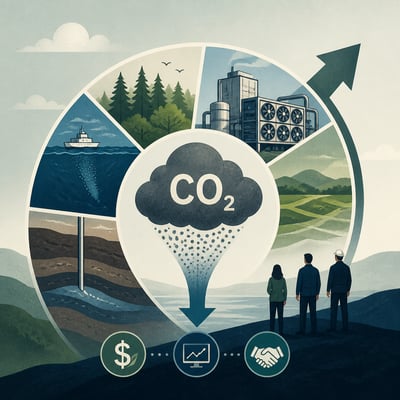
The current material focuses on how carbon dioxide removal could scale to climate-relevant levels by 2040, with emphasis on funding, governance, and trustworthy monitoring for natural and engineered approaches. The strongest recurring signal is the gap between technical potential and the institutions needed to deploy it credibly.
First Article: 02/20/26
Latest Article: 05/12/26
Summary
- Carbon dioxide removal is being framed as a portfolio question rather than a single technology choice, with multiple pathways discussed for 2040 scale-up.
- Natural approaches such as enhanced rock weathering, ocean alkalinity enhancement, and forest carbon capture remain prominent in the discussion.
- Monitoring, reporting, and verification is a central bottleneck, especially for carbon credits and claims of permanence and trust.
- Funding at climate-relevant scale is a persistent concern, with governments, finance, foundations, and companies all treated as potential backers.
- The topic is being discussed in cross-sector terms, linking research, policy design, and market mechanisms rather than science alone.
- The signal is coherent and fairly stable: the main debate is not whether removal exists, but how it can be governed and financed credibly.
History
The story is largely stable, but the framing has sharpened around governance and trustworthy measurement as the main obstacles to climate-relevant carbon removal. It also drops Telluride from the geography and now centers the discussion more tightly on Yale in New Haven.
Featured
Timeline: 82 Days
Hover over any logo to see coverage summary, click for full article.