
 Climate
 Privacy
 Bob Dylan
 Drones
 Data Centers
 AI Governance
 2026 Maine Senate Race
China Expands Clean Energy, Coal Persists
Coverage from The New York Times, Inside Climate News, and others
00/00/0000
Articles
68
Active Days
225
The Topic
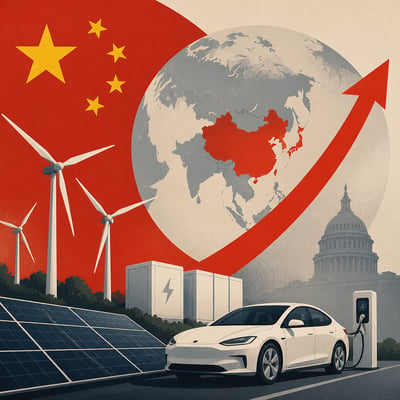
China is expanding wind, solar, batteries, electric vehicles and related manufacturing at a scale that is strengthening its position in global clean-energy supply chains. At the same time, coal generation and new coal capacity remain substantial, while curtailment, limited storage incentives and inflexible grid operations restrict how much renewable power reaches consumers. The combination creates a sustained tension between rapid clean-energy growth, energy security, industrial policy and emissions reduction.
First Article: 01/01/00
Latest Article: 07/20/26
History
The story is now framed more explicitly around China’s dominance in global clean-energy supply chains, with a sharper emphasis on system-level grid and storage constraints limiting how much renewable capacity translates into delivered power. International concerns remain, but they are now presented as part of a broader competition over clean-energy industrial leadership.
The story now extends beyond China’s domestic clean-energy buildout to emphasize international backlash, especially U.S. retreat from clean-energy support and stronger European and British scrutiny of Chinese firms. It also adds a sharper claim that coal remains central to energy security, with new plants and early-2026 generation threatening sustained emissions declines.
- The United States is retreating from some renewable and EV support.
- European and British authorities are scrutinizing Chinese wind-turbine companies.
- New coal plants and higher early-2026 generation threaten emissions declines.
- Industrial subsidies and local-content policies helped Chinese exporters.
- China’s advantage is now linked to international trade and security responses.
The story now adds stronger evidence that China’s clean-energy manufacturing dominance is being reinforced by massive investment shares and continued export expansion, while the framing shifts more toward grid integration and storage as the binding constraints on turning capacity into emissions cuts.
- Chinese firms captured 55% of announced global clean-energy manufacturing investment, 2019-2025.
- Wind and solar capacity surpassed thermal power capacity in 2025.
- Investment subsidies outperformed carbon-allowance allocation in the cited adoption model.
- Energy-security concerns and higher oil and gas prices are boosting electrification support.
- Western governments are adding anti-subsidy measures to security reviews.
The story now places much sharper emphasis on China’s export-and-overseas expansion in clean energy, alongside renewed coal growth that is slowing emissions progress. It also adds a stronger policy and security angle, with Western scrutiny of Chinese suppliers and clearer U.S. policy retrenchment shaping the competitive backdrop.
- China installed more wind capacity in 2025 than the rest of the world combined.
- Renewables reached nearly 60% of China’s total generating capacity in 2025.
- Coal generation and construction rebounded in early 2026.
- China’s first-quarter fossil-fuel and industrial CO2 emissions rose 2% year on year.
- Western authorities are scrutinizing Chinese wind-turbine suppliers for trade and security reasons.
The story has shifted from mainly describing China's clean-energy scale-up to emphasizing the system constraints and policy frictions shaping that transition. Grid integration, trade restrictions, and market distortions like oversupply and negative prices are now central to how the expansion is understood.
- Grid integration is now a central constraint on renewable scale-up.
- Oversupply and negative-price episodes are being linked to rapid clean-energy growth.
- Trade barriers are portrayed as increasing costs and slowing deployment.
- Grid expansion is being tied to jobs and community health outcomes.
- The material is framed as current and operational in 2025-2026.
The framing has shifted from a mostly China-versus-U.S. clean-energy market story to a broader account of China’s clean-tech industrial power extending into global climate and industrial competition. The current version puts more emphasis on overseas market reach and China’s role in shaping worldwide deployment, while the U.S. is now mainly a lagging comparator.
The story now places much more weight on China’s manufacturing overcapacity and the resulting curtailment, margin pressure, and grid instability, rather than just rapid clean-energy deployment. It also sharpens the geopolitical angle by making U.S. policy retreat and trade/security disputes part of the core narrative.
- China’s clean-tech overcapacity is compressing margins.
- Some regions are seeing curtailment and negative prices.
- Coal remains part of China’s balancing and security mix.
- Trade and security disputes are now central to the transition story.
The story has shifted from a broad clean-energy acceleration narrative to one centered more explicitly on grid integration, price disruption, and industrial-climate competition. It also broadens the cast of institutions and commentators shaping the frame, with climate governance and energy-system analysis more prominent than before.
The story is now framed more explicitly around China’s industrial and supply-chain dominance in clean energy, not just its deployment leadership. The new emphasis is on market mechanics—especially solar oversupply and cost pressure—alongside persistent grid-integration constraints and weaker U.S. policy.
The story shifts from a broad clean-energy deployment narrative to a more explicit framing of China as the central industrial and geopolitical force shaping the transition. The new version also sharpens the emphasis on system integration problems and supply-chain dependence as the main bottlenecks.
- China now leads manufacturing, installation, and system integration.
- Mineral processing and export capacity shape clean-tech supply.
- Coal still supplies a large share of electricity in China.
- Negative prices join curtailment and voltage issues as grid symptoms.
- U.S. federal policy is framed as less supportive and more fossil-oriented.
The story has sharpened from general clean-energy expansion into a more specific system-level narrative: China’s buildout now clearly centers on grid infrastructure, storage, and market design, not just more solar and wind. It also places stronger emphasis on China’s manufacturing leverage and energy-security framing, alongside a more explicit contrast with US policy retreat.
The story shifts from broad renewable buildout and policy unevenness to a more specific industrial picture: China is not only leading deployment, but also driving oversupply, price pressure, and trade flows across clean-tech markets. The framing also broadens to include EVs and cleaner system-balancing needs as central parts of the transition.
- Manufacturing supply is outrunning demand in several clean-tech segments.
- Solar oversupply is causing price pressure and margin compression.
- Cross-border clean-energy shipments continue rising despite tariffs.
- Battery storage and EVs are now central to the transition story.
- China increasingly shapes climate diplomacy.
The story broadens from a China-versus-U.S. clean-energy race into a wider transition debate focused on grid limits, supply-chain concentration, and policy uncertainty in Canada as well as the U.S. The framing also shifts from deployment leadership alone to the infrastructure and political conditions needed to sustain scaling.
The story is now framed less as a China-only deployment surge and more as a broader industrial and geopolitical competition, with the U.S. explicitly recast as a policy retrenchment countertrend. The new version also sharpens the claim that scale and cost dynamics are now strong enough to keep the transition advancing despite political headwinds.
- U.S. policy reversal and fossil-fuel support are now highlighted as a countertrend.
- China’s export power and overseas production capacity are newly emphasized.
- Critical minerals and technology dependence are newly tied to the clean-energy story.
- Renewable cost and scale are now framed as sustaining momentum despite politics.
China’s clean-energy buildout is accelerating across solar, wind, batteries, transmission, and electrification, while reshaping global supply chains, pressuring fossil-fuel assets, and triggering trade and security responses abroad.