Last Update: 06/03/2026 at 6:25 AM EST

Climate Tipping Point Risk

Coverage from Astrobiology, Euronews.com, and others

Articles

18

Latest Article

03/23

Active Days

339

Executive Summary

Recent reporting and research describe a warming climate system that is accelerating, absorbing record ocean heat, and moving closer to tipping-point behavior. The strongest signal is a sustained focus on overshoot beyond 1.5C, interacting Earth-system thresholds, and the weakening ability of natural sinks to buffer emissions. Across the material, Greenland and West Antarctic ice sheets, Arctic permafrost, the Amazon, coral reefs, and the AMOC recur as the most important risk elements. The topic is coherent and dense, with scientific uncertainty concentrated in threshold timing, feedback strength, and the likelihood of cascading transitions rather than in the basic direction of change. The topic appears structural and ongoing, not short-term.

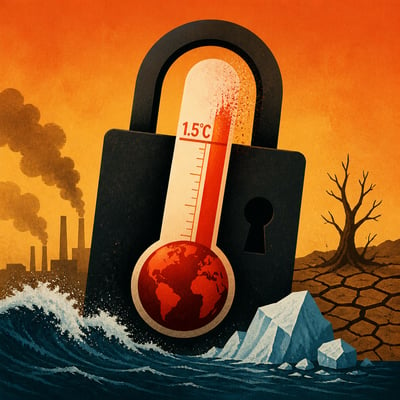
Climate Tipping Point Risk topic image

Key Points

  • Warming is described as accelerating, with multiple pieces citing a recent rise in the warming rate and repeated breaches of the 1.5C threshold.
  • Record ocean heat and a growing Earth energy imbalance are the clearest physical signals of continued heat accumulation.
  • The most repeated risk elements are the Greenland and West Antarctic ice sheets, Arctic permafrost, the Amazon rainforest, coral reefs, and the AMOC.
  • A common concern is that several tipping elements may interact, creating feedbacks that lock in long-lived warming and sea-level rise.
  • Natural carbon sinks in oceans, forests, and soils are repeatedly described as weakening, reducing the planet’s buffering capacity.
  • Mitigation remains the dominant response frame, but negative emissions, carbon removal, and geoengineering are presented as uncertain or underdeveloped.
  • The cluster is scientifically coherent, but threshold timing, cascade probability, and measurement uncertainty remain unresolved.

Featured Article

The Week / Devika Rao02-19-2026
Researchers warn tipping points and hothouse warming could unfold globally if emissions reductions stall.

Coverage Timeline: 339 Days

2025Jan 1Mar 5May 28Jul 30Oct 22Dec 242026Jan 1Mar 5May 28Jul 30Oct 22Dec 24

Additional Articles

⭐⭐⭐⭐⭐

Astrobiology / Keith Cowing02-15-2026
Scientists led by Oregon State University report in 2026 that multiple Earth system tipping elements are closer to destabilization, increasing hothouse trajectory risks globally.
Euronews.com / Rebecca Ann Hughes02-11-2026
On 11 February 2026, scientists led by Oregon State University ecologist William Ripple reported in One Earth that multiple Earth system tipping points are nearing destabilisation.
Eos / Grace van Deelen02-11-2026
Climate scientists in Europe and the United States report in 2024 that accelerating warming and linked tipping points may commit Earth to a hothouse trajectory.
Mother Jones / Fred Pearce01-01-1900
Global climate researchers in Europe and the United States warn in 2025 that accelerating warming and tipping-point risks could render overshoot of 1.5 C effectively permanent.
Potsdam Institute for Climate Impact Research02-19-2026
Researchers from PIK, Exeter and CICERO warn that overshooting 1.5C increases tipping point risk across Earth systems.
The Independent / Stuti Mishra02-12-2026
Researchers warn that tipping points may push global climate toward hothouse warming within this century.
NPR / Rebecca Hersher11-19-2025
At COP30 in Brazil, climate scientists and UN officials in 2025 warn that surpassing 1.5C warming risks triggering coral loss, ice-sheet collapse, and permafrost feedbacks.
Canada's National Observer / Fred Pearce02-16-2026
Overshoot threats rise with emissions.
Jimehansen / James Hansen03-06-2026
Earth scientists warn that runaway climate risk could lock in irreversible ice sheet loss and sea level rise within decades.
Vetromebel.com / Ryan Holloway02-16-2026
Climate researchers in Europe and elsewhere in 2024 highlight early-warning data on AMOC and Amazon tipping risks, urging rapid systemic mitigation measures worldwide.

⭐⭐⭐

The New York Times / David Gelles03-19-2026
Scientists debate global warming acceleration after a March 6 study, with ocean heat, glacier melt, and sea-level rise intensifying faster than expected as El Nino approaches.
Grist / Rebecca Egan McCarthy03-16-2026
Researchers warn this decade that accelerating warming and tipping point risks threaten global climate stability.
Grist / Rebecca Egan McCarthy03-16-2026
Scientists warn that rapid warming could trigger Atlantic circulation collapse and tipping points within decades, risking drought in the Southern Hemisphere and sea level rise on the US East Coast.
The Weather Channel / Jennifer Gray04-26-2025
Researchers report a 62% chance of triggering at least one major climate tipping point, including Greenland melt and permafrost thaw, based on probabilistic modeling published in 2025.
The Climate Brink / Andrew Dessler03-19-2026
Scientific explanations of runaway greenhouse thresholds describe feedback-strength limits and radiative constraints, concluding Earth is not headed for a Venus-like state on human timescales.
The News International03-23-2026
The World Meteorological Organization warned that Earths energy imbalance increased over 2005-2025, driving record ocean heat uptake and elevating warming risk during a forecast El Nino.

⭐️⭐️

The Cool Down / Daysia Tolentino02-22-2026
Oregon State University researchers report accelerating warming and tipping point risk now, urging immediate climate action worldwide.