
 Climate
 Privacy
 Bob Dylan
 Drones
 Data Centers
 AI Governance
 2026 Maine Senate Race
Climate Warming Raises Extreme Weather
Coverage from PBS News, Nature, and others
00/00/0000
Articles
68
Active Days
152
The Topic
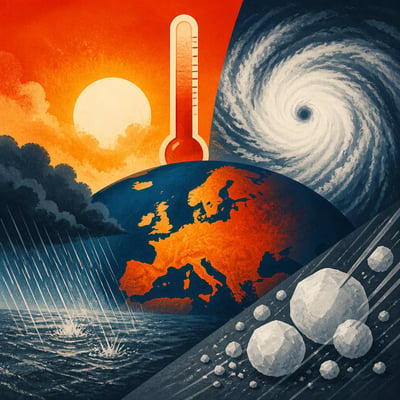
Research and event-attribution analyses indicate that human-caused warming is making some extreme heat events more likely and more severe, while projections show a shift toward larger and more damaging hail in several mid-latitude regions. The consequences include greater risks to health, buildings, vehicles, crops, solar panels, and other infrastructure. Regional outcomes vary, and declining aerosols can influence European circulation, but greenhouse-gas warming remains the dominant driver identified in the material.
First Article: 02/24/26
Latest Article: 07/25/26
History
The update slightly sharpens the framing of the climate impacts, especially by emphasizing that some extreme heat events were effectively impossible before industrial-era warming. It also narrows the hail story with a more specific regional projection for the U.S. Northern Plains and adds a clearer statement that greenhouse gases remain the dominant driver.
The story broadens beyond Europe-centric heat and rain attribution to a wider transatlantic heat-and-hail risk picture, with new emphasis on exceptionally improbable preindustrial heat events in North America and Europe and on future large-hail damage potential. It also reframes the impacts more concretely around health, events, and infrastructure exposure.
- Extreme heat and humidity were judged extraordinarily unlikely in preindustrial climate.
- Late-century models project more hailstones above 30 millimeters.
- Large-hail risk increases are highlighted for Argentina, Canada, and the U.S. Northern Plains.
- Extreme heat caused reported medical impacts, event disruptions, and thousands of excess deaths in Europe.
- Declining aerosols are cited as a contributor to European circulation changes.
The story has broadened from heat attribution and future hail projections into a denser Europe-centered cluster of attribution findings on heat, drought, rainfall extremes, and hail, with 2026 studies emphasizing cascading system impacts and adaptation gaps. The framing now stresses recurring, evidence-heavy analyses and a more integrated risk picture rather than isolated event studies.
- European studies now cover drought intensification and heavier rainfall, not just heat and hail.
- 2026 publications are the main recent source of attribution findings.
- Rapid attribution methods are repeatedly used across the new studies.
- Adaptation gaps in water management and disaster planning are newly emphasized.
- Physical mechanisms like Saharan air transport and reduced aerosols are newly highlighted.
The story now centers more tightly on two fresh scientific findings: event attribution work tying recent heatwaves to human-caused warming, and a new projection that warming will raise the frequency of larger hailstones in some mid-latitude regions. The updated framing is more specific about region-by-region impacts and the different health and property risks posed by heat versus hail.
The story broadened beyond attribution science alone to include a separate governance thread: reduced visibility or disruption in U.S. climate data and emissions reporting. It also expanded the set of actors and risks by adding NOAA, Copernicus, and the European Central Bank, while keeping the core climate-risk amplification narrative intact.
The story has sharpened from a general attribution-and-projection pattern into a more operational account of climate impacts, with heat now tied to visible disruptions in health, transport, schools, and electricity markets. It also places stronger emphasis on attribution methodology itself, while retaining uncertainty around hail and tropical cyclone projections.
The story has broadened from a hail-focused climate-risk narrative into a denser Europe-centered attribution story covering heat, rainfall, hail, and even tropical cyclones. The main shift is from projected hail damage to a stronger emphasis on observed, human-caused extreme weather attribution in recent European events.
- Recent studies tie European heat, rainfall, and hail extremes to human-caused warming.
- Tropical cyclone intensity is now included as a warming-linked hazard.
- The evidence base has expanded to 31 articles, from 15 previously.
- University of Graz is now a named lead institution for a heat-hazard study.
- Recent analyses cover events from 2024 to 2026 with historical baselines.
The framing has broadened from a general hail-hazard/adaptation story to a more specific emphasis on projected geographic and seasonal shifts, with Europe and insurance losses now more central. The current version also adds stronger attention to at-risk assets like roofs, vehicles, and solar infrastructure.
The story has shifted from broad attribution of extreme weather to a more specific and actionable hail narrative: research now emphasizes where hail risk is rising or falling, and practical adaptation responses are starting to appear. Colorado’s roofing-grant response and the focus on insurance and damage mitigation make the topic more implementation-oriented than before.
- Hail risk appears to rise more in mid-latitudes than in the tropics.
- Colorado launched a state-backed roofing grant response to hail losses.
- Insurance costs are now part of the story.
- Hail-resistant roofing is highlighted as an adaptation measure.
- Global climate models still do not resolve hail explicitly.
Recent research links human-caused warming to stronger hail, heavier downpours, more severe heat, and more intense hurricanes, with Europe appearing especially prominent in the latest studies.