
 Climate
 Privacy
 Bob Dylan
 Drones
 Data Centers
 AI Governance
 2026 Maine Senate Race
CO2 Drives Stratospheric Cooling
Coverage from Yale E360, EurekAlert!, and others
Articles
4
Active Days
57
The Topic
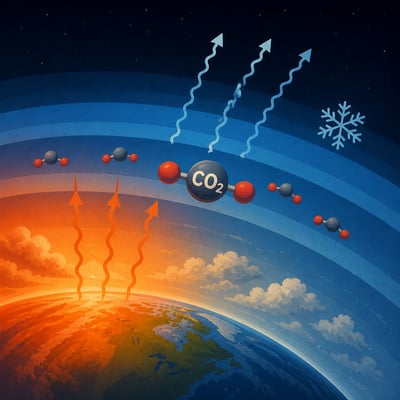
A Columbia University study develops a quantitative explanation for the long-observed cooling of the stratosphere as atmospheric carbon dioxide rises. The mechanism centers on changes in infrared radiation: in the thin upper atmosphere, additional CO2 increases heat loss to space, while the resulting cooler stratosphere reduces total outgoing energy and reinforces warming below. The work could improve climate modeling and inform research on related effects involving ozone, satellites, and other planetary atmospheres.
First Article: 05/11/26
Latest Article: 07/06/26
Summary
- Researchers identify wavelength-dependent infrared radiation as the main mechanism behind CO2-induced stratospheric cooling.
- The stratosphere has cooled by roughly 2 degrees Celsius since the mid-1980s, with stronger cooling at higher altitudes.
- The framework estimates substantial cooling near the upper stratosphere for each doubling of CO2 and matches established observations.
- Ozone and water vapor contribute to the process but have a smaller influence than CO2 in the study’s analysis.
- A cooler stratosphere allows less total infrared energy to escape to space, strengthening heat retention in the lower climate system.
- Potential implications for ozone recovery and satellites are identified as areas requiring further study.
- One separate article challenges a direct link between rising CO2 and observed ocean radiative flux trends, but it is not closely integrated with the stratospheric-cooling research.
History
The story is modestly expanded to emphasize downstream implications of the stratospheric-cooling mechanism, especially possible effects on ozone recovery, satellites, and other planetary atmospheres. It also adds a separate, loosely related challenge to CO2-linked ocean radiative-flux interpretations, though that does not directly alter the stratospheric-cooling finding.
Featured
Timeline: 57 Days
Hover over any logo to see coverage summary, click for full article.