
 Climate
 Privacy
 Bob Dylan
 Drones
 Data Centers
 AI Governance
 2026 Maine Senate Race
Egypt Expands Renewable Power And Storage
Coverage from Reuters, APM Terminals, and others
Articles
13
Active Days
104
The Topic
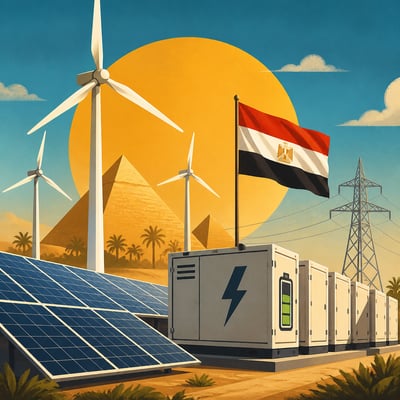
Egypt is advancing a coordinated electricity strategy that combines grid strengthening, solar and wind integration, battery storage and continued fuel-supply planning. The government is pursuing a higher renewable share while managing rising summer demand and the reliability risks exposed by earlier power shortages. EU financing and clean-power agreements for major port operations add international and commercial support to the transition.
First Article: 03/24/26
Latest Article: 07/05/26
Summary
- The government is reviewing roughly 105 grid-strengthening projects and plans to connect additional solar and wind capacity by 2027.
- Egypt plans to raise renewables to 45% of its electricity mix within two years, supported by grid-connected and standalone storage.
- The first Obelisk solar phase combines 500 MW of generation with 200 MWh of battery storage; a second 500 MW phase is planned.
- A proposed €690 million EU-backed package would support grid upgrades intended to integrate 22 GW of renewable capacity by 2030.
- Fuel coordination remains important as summer electricity demand is expected to rise 8% above the previous record peak.
- Suez Canal Container Terminal agreed to source all of its electricity from renewable sources, potentially avoiding about 30,000 tonnes of CO2 annually.
- The transition links energy security, grid reliability, emissions reduction and Egypt’s position as a regional energy hub.
History
The story has shifted from active project execution to a more integrated framing that ties grid upgrades and renewables to energy security, emissions reduction, and Egypt’s regional trade role. The biggest new element is the explicit commercial link through the port electricity deal, alongside a slightly more cautious description of the EU package as proposed.
The story has shifted from a general renewable buildout to a more urgent near-term reliability and fuel-supply challenge, with summer demand stress now driving grid, storage, and LNG coordination. It also adds clearer execution milestones, including a large EU-backed transmission package and an operating solar-plus-storage project.
Featured
Timeline: 104 Days
Hover over any logo to see coverage summary, click for full article.