
 Climate
 Privacy
 Bob Dylan
 Drones
 Data Centers
 AI Governance
 2026 Maine Senate Race
European Battery Storage And Grid Strain
Coverage from Inside Climate News, Reuters, and others
Articles
34
Active Days
1285
The Topic
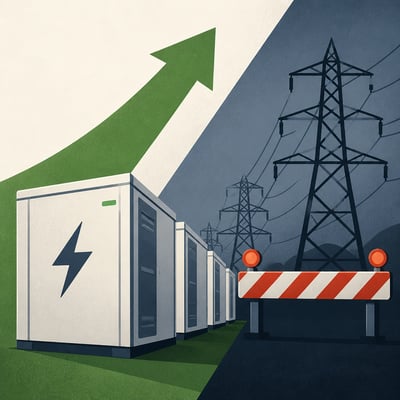
Battery storage is expanding quickly across Germany, Europe, and the United States, but grid bottlenecks, interconnection delays, curtailment, and falling capture prices are increasingly shaping how useful that capacity is. Germany stands out for both rapid storage growth and persistent flexibility and price problems in its power system.
First Article: 01/01/23
Latest Article: 07/08/26
Summary
- Battery storage deployment is rising rapidly in Germany and across Europe, with record additions and total installed capacity moving above 100 GWh in Europe.
- Grid flexibility is now a binding constraint: interconnection queues, transmission limits, and distribution bottlenecks delay projects and reduce usable output.
- High solar growth is creating midday oversupply, negative prices, and curtailment, especially in Germany and Spain.
- Germany combines strong renewable expansion with high household electricity prices, showing that more wind and solar alone do not automatically lower consumer bills.
- Storage is increasingly treated as system infrastructure rather than a niche technology, with utility-scale projects, hybrid solar-plus-storage systems, and household batteries all gaining importance.
- Policy and regulation are becoming more active around storage, including FERC queue reform in the U.S. and EU digital and traceability rules for batteries.
- Economic uncertainty remains important: battery revenues depend on arbitrage and multiple revenue streams, while margins can compress as deployments scale.
History
The story has broadened from a general storage-and-grid bottleneck narrative into a more explicit system-wide constraint story, emphasizing curtailment, negative prices, and falling capture prices as the key limits on battery usefulness. It also adds a clearer regulatory dimension, with policy action now highlighted in both the U.S. and EU.
The story has broadened from a Europe-centered solar-storage and inverter-policy narrative into a wider power-system flexibility story spanning Europe and the United States. Germany is now the clearest focal point, and the emphasis has shifted from supply-chain restrictions to grid access, market design, and reliability constraints.
Featured
Timeline: 1285 Days
Hover over any logo to see coverage summary, click for full article.