
Last Update: 06/03/2026 at 7:50 AM EST
Europe's Energy Security Transition
Coverage from Reuters, Earth.Org, and others
Articles
26
Latest Article
06/01
Active Days
78
Executive Summary
Recent coverage links Europe’s renewable rollout to energy security, price stability, and reduced fossil import dependence, while also showing that grid limits, permitting delays, and market design still weaken the transition. Geopolitical shocks, especially Middle East supply disruptions, are reinforcing the case for wind, solar, storage, and interconnection, but the policy and investment response remains uneven across countries.
Key Points
- Geopolitical fuel shocks remain the main trigger for urgency, especially disruptions affecting oil and gas flows through the Strait of Hormuz and broader Middle East instability.
- Wind and solar are increasingly framed as tools for energy security because they reduce exposure to imported fossil fuels and volatile commodity prices.
- Europe-wide data and analysis suggest renewable growth is lowering wholesale electricity prices in many markets, but retail bills often do not fall in parallel.
- Grid capacity, storage, interconnection, and market design keep emerging as major bottlenecks, limiting how much renewable generation can translate into lower costs.
- Permitting and political resistance continue to slow deployment in key countries, with Italy highlighted as a case where project timelines and policy ambiguity delay offshore wind buildout.
- EU energy strategy is shifting toward diversification, LNG flexibility, interconnectors, and coordinated supply planning, but many clean-energy deals remain non-binding or fragmented.
- Finance flows are increasing, but capital is still unevenly distributed and sensitive to interest rates, inflation, and project risk.
Featured Article
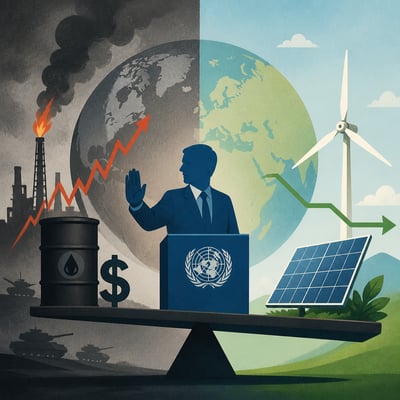
UNFCCC secretary and European ministers highlight renewables as a shield against fossil fuel dependence at a Brussels summit on March 16.
Coverage Timeline: 78 Days
Hover over any logo to see coverage summary, click for full article.
Additional Articles
⭐⭐⭐⭐⭐
Europe links an Iran-triggered oil and fuel price shock to REPowerEU progress and a new clean-energy investment strategy to accelerate electrification, storage, and geothermal through 2030.
Max Planck Institute for Chemistry researchers model EU fuel-price shocks and find that earlier net-zero via large-scale renewable expansion can yield net benefits after accounting for energy and health co-benefits.
Ember and IEA-linked analysis in 2025 and early 2026 reports renewable wind and solar growth cutting EU fossil import spending during geopolitical price shocks.
European and US electricity price analysis finds renewables correlate with lower wholesale prices, while retail bills depend more on non-wholesale costs and gas-setter hours.
⭐⭐⭐
Copenhagen Infrastructure Partners warned Italy lacked a planned offshore wind auction timetable as fossil-gas dependence and energy-price shocks increased pressure on renewable deployment.
European countries are reassessing energy-market design after war-linked fuel price spikes expose how gas and coal marginal pricing can offset renewable gains.
Positive Money analysis of 19 European countries links 2023-2025 renewable expansion to about 24% lower wholesale electricity prices and reduced gas price pass-through.
European Union policymakers and the European Investment Bank in the 2020s are using grid and clean-energy financing initiatives to speed renewable deployment amid permitting delays and higher capital costs.
Energy Transitions Commission report argues renewables and electrification after the Hormuz Strait disruption can reduce oil and gas exposure to future shocks.
Stanford professor Mark Z. Jacobson reported that CAISO wholesale electricity prices were lowest in the U.S. for 2025-26 as wind, water, and solar met demand for many 2026 days.
Geopolitical oil and gas disruptions are driving higher energy costs during the 2020s, with clean energy investment promoted as a path to cost stability and resilience.
UN climate leadership ties Middle East conflict-driven fossil fuel price shocks to inflation and hunger, and points to COP30 grid and storage commitments to accelerate clean energy.
Simon Stiell told GX Week in Yeosu that Middle East-driven fossil fuel cost volatility shows why South Korea should accelerate solar and wind while funding flood, storm, and extreme-heat resilience.
ECFR analysis assesses how EU and member states expanded energy diplomacy from 2022 to 2026 to diversify fossil gas supplies and pursue hydrogen and critical raw materials agreements.
EU energy security planning in 2024 and 2025 highlights fossil import vulnerabilities from disruptions like the Strait of Hormuz while adding climate and cyber infrastructure risks.
In 1979, President Jimmy Carter advanced White House solar and a U.S. solar strategy, linking renewables to energy security after oil shocks driven by geopolitical disruptions.
Cuba experiences major blackouts as oil deliveries decline, while rapidly installed solar parks raise electricity generation and reduce exposure to fossil fuel supply disruptions.
Storebrand Renewable Energy is described as an investment vehicle for renewable grid, storage, and generation trends driven by energy security and electrification.
EU leaders after Iran-related strikes urged faster wind and solar deployment to reduce imported oil and gas costs and improve energy security.
SEB released the Sustainable Finance Outlook in 2026, citing Middle East conflict and carbon costs as drivers of faster clean-energy and sustainable aviation fuel transitions in Europe.
EU energy diplomacy since 2022 diversified fossil fuel supplies and expanded LNG and interconnectors, but proposed coordination and binding commitments remain limited as of 2026 planning.
⭐️⭐️
In Brussels on a policy briefing, Simon Stiell warns that fossil fuel dependence risks security and price shocks, urging renewables expansion.
UNFCCC head in Brussels cites Europe energy price surge and fossil fuel dependence, urging transition to renewables and nuclear.
UNFCCC official Simon Stiell argues renewables reduce fossil fuel dependence at the 2026 Green Growth Summit in Brussels.
A climate and energy security analysis links oil supply disruptions to fossil fuel dependence and argues renewable electricity deployment can reduce both geopolitical disruption and climate-driven extreme weather risk.