
Last Update: 06/03/2026 at 6:50 AM EST
European Battery Storage And Grid Limits
Coverage from Energy Storage, Euronews, and others
Articles
13
Latest Article
06/01
Active Days
1248
Executive Summary
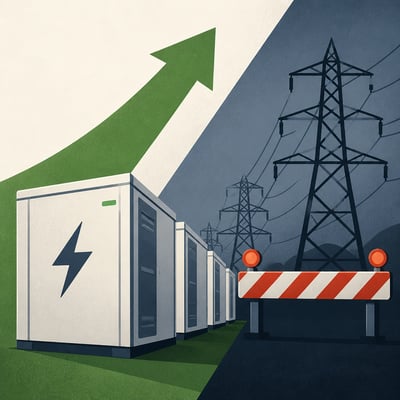
Battery storage is expanding quickly in Germany and across Europe, but grid connection limits, curtailment, and reliability needs are now shaping how fast it can scale. Solar growth, lower battery costs, and investment interest are pulling the market forward, while policy and infrastructure lag remain persistent constraints.
Key Points
- Germany and the wider European market are adding battery storage at a fast pace, with both residential and utility-scale systems contributing to growth.
- Solar deployment is still the main driver of storage demand, especially for self-consumption, evening shifting, and balancing variable output.
- Grid bottlenecks are a central constraint: interconnection queues, slow approvals, and limited transmission and distribution capacity keep slowing deployment.
- Curtailment is becoming more visible as sunny-day solar output outpaces grid absorption, especially in parts of Europe with high renewable penetration.
- Storage is increasingly framed as grid infrastructure, not just a customer-side product, because it can provide frequency support, voltage stability, and flexibility services.
- Investment activity remains strong, with developers and funds building large pipelines and acquiring storage platforms tied to the transition.
- Longer-term reliability questions remain unresolved, especially around whether storage alone can cover low-wind, low-solar periods without some dispatchable backup.
Featured Article
BSW-Solar reports Germany's storage capacity rising to over 25 GWh, with plans for 100 GWh by the decade's end.
Coverage Timeline: 1248 Days
Hover over any logo to see coverage summary, click for full article.
Additional Articles
⭐⭐⭐⭐⭐
Thema Consulting Group modeled Germany 2035 Dunkelflaute events and finds battery storage alone does not prevent high-price winter spikes.
In Europe during the 2020s, faster solar deployment is increasing demand for household and grid battery energy storage as battery costs fall and tariffs shift consumption timing.
In 2025, Germany led the EU in wind and solar generation but reported higher household electricity prices in 2025 due to merit-order pricing and limited grid flexibility.
⭐⭐⭐
Westnetz completed the first test of the SUREVIVE 21 MW/55 MWh grid-forming battery in Foehren, Germany, for frequency and voltage stabilization.
BloombergNEF reports European solar generation curtailment as grids cannot absorb peak output, with battery buildout and subsidy targeting required to manage system integration.
SolarPower Europe links EU solar deployment to about 10 billion EUR avoided gas imports since early-year conflict escalation and projects Solar+ plus storage can halve EU power system costs by 2030.
Europe expands balcony plug-in solar as energy security concerns rise, supported by incentives and eased rules across Germany, Belgium, Spain, and the UK.
In 2025, U.S. battery storage reached 57 GWh amid grid interconnection queue reforms under FERC Order 2023 and tightening arbitrage-based revenues in California and Texas.
⭐️⭐️
ADS-TEC Energy and Stadtwerke Muehlacker announce a 10 MW 20 MWh battery storage project in Muehlacker Germany to improve grid stability in January 2026.
US energy authorities report in 2026 that 86 GW of capacity will be added nationwide, led by solar and battery storage.
Germanys energy transition market is expected to grow from about 132.5 billion in 2024 to about 263.3 billion by 2035 as renewables, storage, and hydrogen expand.
Foresight Group acquired Mirai Power for Foresight Energy Infrastructure Partners II to expand Germany BESS development and a 12.5GW pipeline.