
 Climate
 Privacy
 Bob Dylan
 Drones
 Data Centers
 AI Governance
 2026 Maine Senate Race
European Battery Storage And Grid Strain
Coverage from Inside Climate News, Reuters, and others
00/00/0000
Articles
34
Active Days
1285
The Topic
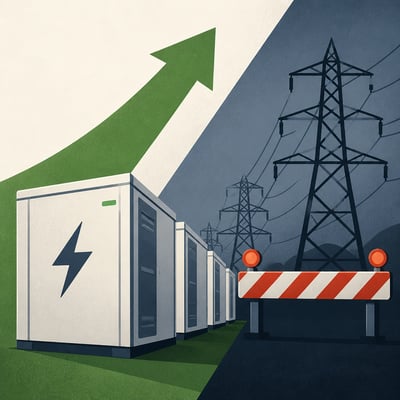
Battery storage is expanding quickly across Germany, Europe, and the United States, but grid bottlenecks, interconnection delays, curtailment, and falling capture prices are increasingly shaping how useful that capacity is. Germany stands out for both rapid storage growth and persistent flexibility and price problems in its power system.
First Article: 01/01/23
Latest Article: 07/08/26
History
The story has broadened from a general storage-and-grid bottleneck narrative into a more explicit system-wide constraint story, emphasizing curtailment, negative prices, and falling capture prices as the key limits on battery usefulness. It also adds a clearer regulatory dimension, with policy action now highlighted in both the U.S. and EU.
- Europe's total installed battery capacity has moved above 100 GWh.
- Spain is newly highlighted as a major curtailment and oversupply market.
- FERC queue reform is now explicitly part of the story.
- EU digital and traceability rules for batteries are now in view.
- Battery margins may compress as deployments scale.
The story has broadened from a Europe-centered solar-storage and inverter-policy narrative into a wider power-system flexibility story spanning Europe and the United States. Germany is now the clearest focal point, and the emphasis has shifted from supply-chain restrictions to grid access, market design, and reliability constraints.
- U.S. interconnection queues and study delays are now a major constraint.
- Germany is the central focal point for storage growth and price pressures.
- Reliability concerns are highlighted for low-wind, low-solar periods.
- Storage revenue now depends on grid fees and revenue stacking.
- The story now includes both Europe and the United States.
The story has shifted from general growth in European solar-storage deployment to a more specific view of battery storage as a central system asset, backed by record capacity milestones and stronger financing. At the same time, EU restrictions on Chinese inverter funding are now a clearer policy constraint that could raise costs and slow some solar projects.
- European battery storage capacity has crossed 100 GWh.
- Record additions continued into 2026.
- EU limits on public funding for Chinese-made solar inverters.
- Some battery manufacturing efforts tied to EVs have struggled.
- Utility-scale battery storage now leads new installations.
The story now gives more weight to plug-in and rooftop solar growth and to investor behavior, showing that storage is increasingly being treated as financeable flexibility infrastructure rather than just a technical grid fix. EU inverter security measures also appear more concretely as a cost and procurement disruption.
The story shifts from a broad Europe-wide expansion narrative to a more specific emphasis on grid integration economics: batteries are now framed as increasingly dependent on dispatch software, market rules, and revenue stacking, not just installed capacity. The current version also adds stronger focus on EU inverter funding restrictions as a security-and-cost constraint and on investment moving away from EV batteries toward grid-scale storage.
The story has broadened from Germany-centered storage and grid pressure to a more explicit Europe-wide market and security issue. The biggest new element is tighter scrutiny of Chinese inverter hardware, alongside clearer evidence that solar-plus-storage is now the default project model amid grid congestion and volatile economics.
- Security restrictions may slow solar deployment by limiting inverter sourcing.
- Solar-plus-storage has become the default model for new renewable projects.
- European EV-battery supply chains are facing bankruptcies and delays.
- The story now includes the UK, Italy, Poland, and Lithuania.
- Stationary storage in Germany now exceeds 25 GWh.
The story has broadened from a general battery-storage growth narrative into a more policy- and system-specific account of Europe’s power transition, with Germany now framed as the clearest example of grid, pricing, and reliability stress. New emphasis also appears on policy responses and security concerns, not just deployment and congestion.
Battery storage is expanding quickly in Germany and across Europe, but grid connection limits, curtailment, and reliability needs are now shaping how fast it can scale. Solar growth, lower battery costs, and investment interest are pulling the market forward, while policy and infrastructure lag remain persistent constraints.