
 Climate
 Privacy
 Bob Dylan
 Drones
 Data Centers
 AI Governance
 2026 Maine Senate Race
Europe Presses Climate Adaptation Reform
Coverage from Nature, IMF, and others
Articles
9
Active Days
157
The Topic
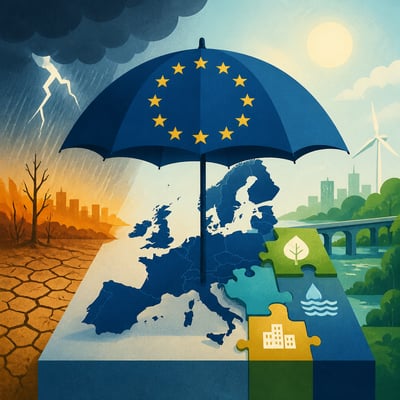
European climate adaptation planning is under pressure from intensifying heat, floods, droughts, wildfires, sea-level rise and coastal risks. Research and policy recommendations call for common risk assessments, clearer resilience goals, stronger investment and monitoring, and adaptive pathways that use regulatory, funding, recovery and infrastructure-renewal windows to expand options while avoiding maladaptation. A parallel debate concerns which warming scenarios, including 1.5°C overshoot and lower-warming pathways, should guide EU planning.
First Article: 02/16/26
Latest Article: 07/22/26
Summary
- European adaptation efforts are described as insufficient and fragmented relative to the scale and pace of rising climate risks.
- The European Scientific Advisory Board on Climate Change recommends common risk assessments, shared scenarios, a 2050 resilience vision, monitoring and stronger public and private finance.
- Academic research identifies EU directives, post-disaster recovery funds, public attention after disasters and aging infrastructure as potential windows for adaptation action.
- Adaptive pathways planning is presented as a way to sequence measures, preserve future options and reduce maladaptive lock-in.
- Coastal protection, dams, storm surge barriers, water storage, urban flood management and nature-based solutions are recurring application areas.
- The material highlights disagreement over scenario design, including whether EU planning should explicitly include 1.5°C overshoot and lower-warming pathways alongside higher-warming assumptions.
- Adaptation is repeatedly framed as necessary but limited, requiring continued emissions reductions to constrain future risks.
History
The story has shifted from a general push for better-coordinated adaptation toward a more specific framework centered on adaptive pathways, resilience targets, and scenario choices. The biggest new issue is disagreement over which warming pathways EU planning should explicitly prepare for, including 1.5°C overshoot.
The story now places more emphasis on financing and execution gaps, while also clarifying that the evidence base is largely coming from European research and advisory institutions. The main policy direction remains the same, but the framing is sharper around implementation constraints and timing.
Featured
Timeline: 157 Days
Hover over any logo to see coverage summary, click for full article.