History
07/24/20260 new articles
The story now adds a stronger legal and procedural dimension: renewable groups are actively challenging the federal review changes in court, while the current framing drops the earlier emphasis on tariffs and foreign-entity tax-credit risks. It also sharpens the permitting bottlenecks by naming Defense airspace/military-radar review and Army Corps approvals as key constraints.
07/23/20260 new articles
The story sharpens from broad permitting bottlenecks into a more specific picture of Trump-administration review changes actively slowing or jeopardizing projects, with quantified impacts on stalled capacity and costs. It also adds separate tariff and foreign-entity rules as new sources of risk for projects already underway.
- About 7 GW of renewable capacity on federal land was stalled or canceled in 2025.
- Developer survey found delays averaging more than six months.
- Development costs commonly increased 6% to 10%.
- Tariffs and foreign-entity rules add new cost and tax-credit risks.
07/23/20264 new articles
The story broadens beyond permitting bottlenecks for generation projects to include transmission, and it more explicitly links those delays to rising electricity demand and grid expansion needs. The latest version also emphasizes ongoing congressional reform efforts amid unresolved litigation, reinforcing that the policy environment remains unsettled.
07/01/20265 new articles
The story has shifted from a broad permitting-reform debate to a more quantified and operational risk picture for renewable projects, with new estimates of capital and capacity exposed to delay. It also now adds specific federal agencies and litigation pressure as active drivers of the bottleneck.
- Wood Mackenzie estimates over $121 billion in investment is at risk.
- About 92 GW of projects face elevated permitting risk.
- Private-land projects still need federal permits through environmental approvals.
- Court injunctions are now affecting permitting timelines.
- Interior, Defense, and Army Corps reviews are explicitly implicated.
06/17/2026Topic Formed
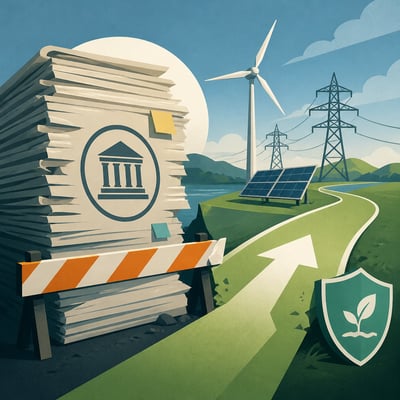
Federal permitting has become a central bottleneck for clean energy and broader energy infrastructure, with developers reporting months-long delays, higher costs, and project siting decisions shaped by review risk. The topic is now moving through Congress as lawmakers seek a bipartisan reform package that would make outcomes more predictable while preserving environmental and legal safeguards. Recent legislative proposals also reflect concern about executive interference with already permitted projects and the need to expand transmission and related infrastructure faster.

 Climate
 Privacy
 Bob Dylan
 Drones
 Data Centers
 AI Governance
 2026 Maine Senate Race