History
07/22/20260 new articles
The story now places more emphasis on renewables’ cost advantage over new fossil power and adds a new quantified claim about avoided fossil-fuel spending. It also sharpens the framing of the main constraints as grid modernization, financing, and hard-to-abate sectors rather than broader deployment challenges.
07/22/20260 new articles
The story broadens from a narrow focus on firm solar-and-storage economics to a wider view of renewable power as a firm, competitive electricity source across hybrid systems and hard-to-electrify applications. The current version also adds new stakeholder emphasis on utilities and industrial users, and explicitly identifies aviation and cement as sectors still lacking easy renewable substitutes.
07/22/20260 new articles
The story shifts from a general claim that renewables are becoming cost-competitive to a more concrete 2025 picture in which firm solar-plus-storage is already priced in the low tens of dollars per megawatt-hour in strong-resource regions. The emphasis also moves toward execution constraints—grid capacity, financing, permitting, and prolonged low-output periods—as the main limit on broader adoption.
07/22/20260 new articles
The story is slightly more specific about how firm renewable power is getting cheaper and where the main limits still sit. The new version adds a stronger emphasis on geography, storage design, and long-run cost projections, while keeping the core competitiveness narrative intact.
07/20/20263 new articles
The story has sharpened from a broad cost-competitiveness trend into a more explicit firm-power narrative: solar, wind, and batteries are now described as approaching parity with new coal and gas in many markets, with 24/7 renewable systems taking center stage. The main constraint set is unchanged, but the regional gap is more explicit, with high-resource markets closer to parity than the United States and some others.
05/27/20263 new articles
The story has shifted from a general case that renewable objections are outdated to a more specific, stronger claim that firm solar- and wind-plus-storage power is becoming cost-competitive in many markets. The emphasis is now on an ongoing structural transition, with broader deployment evidence and clearer framing around grid and financing as the main remaining constraints.
05/16/2026Topic Formed
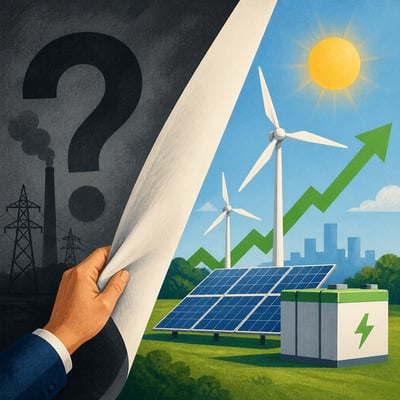
The material centers on recent data arguing that common objections to renewable energy are increasingly outdated. It emphasizes falling solar, wind, and battery costs, plus growing evidence that renewables paired with storage can provide reliable power at competitive prices. Grid bottlenecks, financing gaps, and slow infrastructure buildout remain the main constraints, rather than basic technology limits.

 Climate
 Privacy
 Bob Dylan
 Drones
 Data Centers
 AI Governance
 2026 Maine Senate Race