
 Climate
 Privacy
 Bob Dylan
 Drones
 Data Centers
 AI Governance
 2026 Maine Senate Race
US Heat Pumps Gain Ground
Coverage from PBS News, ScienceDirect, and others
00/00/0000
Articles
62
Active Days
249
The Topic
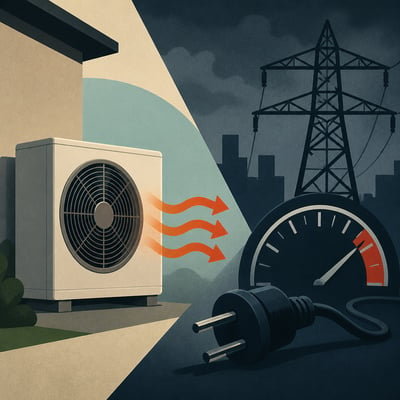
Heat pumps are gaining ground in U.S. buildings as shipments, new-home installations, and multifamily adoption continue to rise, while newer systems increasingly support both heating and cooling in cold conditions. Lower-cost window units and advances in controls, storage, and system integration could broaden access, but performance still varies with extreme cold, frost, system design, and installation conditions. The trend matters because more efficient electric heating can reduce building energy use and fossil-fuel dependence, while also increasing the importance of reliable winter performance and electricity planning.
First Article: 01/26/26
Latest Article: 10/01/26
History
The story now emphasizes broader market penetration: heat pumps are not just rising in shipments and new housing, but also gaining traction in multifamily buildings. The framing also tightens around winter reliability, highlighting cold extremes, frost, and installation conditions as the key remaining constraints.
The story is broadly unchanged, but it now places more emphasis on policy uncertainty and market access constraints rather than just technical performance. The main new wrinkle is that expired federal subsidies are joined by standards litigation and uneven local support, reinforcing a more uncertain adoption environment.
The story has shifted from a broad adoption narrative, with Europe leading, to a more U.S.-specific market picture centered on housing deployment, cold-climate performance, and end-user access. It also adds a notable policy change: federal consumer subsidies expired in 2025, increasing reliance on state and local support.
- U.S. shipments and installations are nearing furnace levels in some measures.
- Window-mounted models can serve renters and retrofit-constrained owners.
- Defrost-control failures can reduce efficiency in severe winter conditions.
- Federal consumer subsidies expired in 2025.
- Reported resale premiums appear in listings but are not clearly causal.
The story now frames heat pumps more as a mainstream decarbonization tool and adds a new product-innovation angle aimed at lowering adoption barriers. It also broadens the policy and system context by highlighting utility/grid readiness and Oregon’s demand growth pressures.
The story has shifted from a broad account of heat pump adoption and constraints to a more specific framing: Europe is now the clearest growth engine, while U.S. analysis focuses more sharply on uneven household economics and grid consequences. The current version also adds consumer-financing and awareness as practical adoption barriers and introduces Oregon-specific demand-growth concerns.
The story has shifted from a broad assessment of heat pump economics and policy into a more explicitly mainstream-deployment narrative, with flexibility and grid management now central to the framing. It also introduces new institutional emphasis from European and Oregon actors and adds thermal storage as a concrete integration path.
The story now has a sharper economic split: heat pumps look clearly favorable for oil, propane, and resistance-heated homes, but remain less attractive for many natural-gas households, especially in cold or high-power-price regions. The update also adds market recovery and product innovation, showing the sector is maturing even as grid, supply-chain, and regulatory constraints persist.
The story has broadened from general heat pump adoption economics into a more explicit policy-and-infrastructure playbook, with hybrid systems, rate design, and grid planning now presented as practical enablers of faster uptake. The updated version also adds new actor and regional emphasis, especially on European and North American policymakers and Oregon-related demand planning.
The story has broadened from a policy-and-economics adoption narrative to one that more explicitly includes commercial building use, supply-chain constraints, and a new startup-linked actor. The framing also shifts toward mainstream deployment, with structural growth in building electrification becoming the central takeaway.
The story has shifted from a broad account of heat pumps as a decarbonization tool to a more practical scaling narrative centered on where they are cheapest, how they affect power systems, and what policies can support adoption. Europe now looks like the clearest adoption leader, while U.S. coverage increasingly emphasizes household economics and grid-planning pressures.
- Germany is posting very high heat pump shares in new residential construction.
- IEA analysis finds broad cost competitiveness across EU markets.
- Heat pumps can be costlier for some natural-gas homes in cold or high-price regions.
- Tariff reform and demand response are emerging as grid-management needs.
- Oregon planning now links heat pumps to data-center-driven load growth.
The story is reframed from a general deployment and subsidy issue into a broader building-electrification transition that now places more weight on electricity demand, refrigerant emissions, and dual-use heating/cooling relevance. It also shifts from emphasis on cold-weather performance to a more balanced view that cold-climate viability has improved while system design and grid planning remain the key constraints.
The story now places much more emphasis on heat pumps as a cooling solution as well as a heating technology, reflecting rising heat risks. It also sharpens the framing around policy design, installer capacity, and grid/building upgrades as the main determinants of whether deployment can scale.
The story has sharpened from broad adoption and implementation barriers into a more specific market picture: heat pumps are now framed as the main low-carbon alternative, but the key uncertainty is whether they actually lower household bills across different regions and fuel types. The geographic emphasis also broadened, with stronger evidence of European momentum and a more mixed U.S. adoption outlook.
The story shifts from a broad adoption narrative to a more implementation-focused one, emphasizing that real-world performance and installation constraints are now the key determinants of heat pump rollout. It also adds a stronger systems lens, tying deployment more explicitly to broader electrification infrastructure and grid planning.
Heat pumps are moving from niche climate technology to mainstream building electrification, supported by falling renewable electricity costs, policy incentives, and energy-security goals. The main constraints are retrofit difficulty, high upfront costs, installer shortages, supply-chain limits, grid impacts, and uneven economics for gas-heated homes.