
 Climate
 Privacy
 Bob Dylan
 Drones
 Data Centers
 AI Governance
 2026 Maine Senate Race
Clean Energy Advances Amid Federal Pushback
Coverage from Grist, Heatmap News, and others
00/00/0000
Articles
42
Active Days
183
The Topic
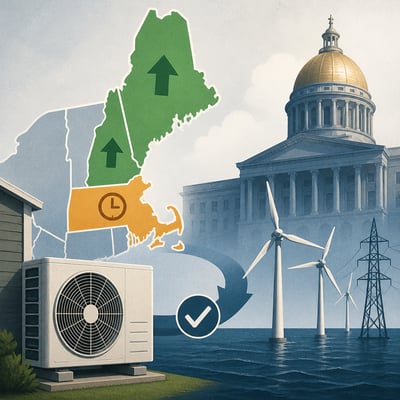
Clean-energy activity is continuing in parts of the United States despite federal efforts to reduce support for renewables, with states such as Maine, Massachusetts, Maryland, and California advancing heat pumps, solar, geothermal systems, and decarbonization policies. Offshore wind is the clearest area of retreat: project cancellations, permitting uncertainty, and rising costs have weakened investor confidence even as the Northeast expects electrification to increase demand for new power. The broader transition is therefore advancing unevenly, shaped by state action and market conditions but limited by grid capacity, skilled labor shortages, local opposition, and unequal access to clean technologies.
First Article: 01/01/00
Latest Article: 07/06/26
History
The story now puts more emphasis on solar and battery storage as active substitutes for clean power growth, while offshore wind is framed as even more weakened by cancellations, costs, and investor pullback. It also broadens slightly with California’s role and adds more explicit concern about community-level distributional impacts.
The story broadens from a Northeast-focused heat pump and offshore wind policy narrative into a wider clean-energy transition story that includes rising electricity demand, geothermal workforce bottlenecks, and Asia’s policy moves. The biggest new development is that federal reversals and project cancellations are now described as directly weakening offshore wind investment confidence, while Maine’s heat pump growth is shown to be ahead of schedule.
- Maine surpassed its initial heat pump installation goal ahead of schedule.
- Federal actions are causing offshore wind project cancellations and investor pullback.
- Rising electricity demand is increasing need for storage and transmission.
- Massachusetts is launching training to address geothermal drilling shortages.
- China and Japan now feature in the clean energy transition story.
The story now places much greater weight on New England-specific execution: state rebates and Massachusetts’s delayed Clean Heat Standard are the main policy drivers, while winter grid demand and offshore wind constraints are becoming central to electrification planning. Federal policy fights and permitting bottlenecks also loom larger as practical barriers to rollout.
- Maine and New England rebate programs show the strongest deployment momentum.
- Massachusetts delayed its Clean Heat Standard until 2028.
- Winter grid demand is now linked to heat pump expansion in the Northeast.
- Trump administration actions are disrupting clean energy grants and offshore wind.
- Permitting delays are recurring across electrification rollout.
The story broadens beyond Northeast heat pump policy into a wider building-electrification and clean-energy implementation issue, with new attention to municipal rules, district heating conversion, workforce constraints, and federal tax-credit legal uncertainty. At the same time, the framing shifts from mostly adoption and affordability to how multiple policy layers and infrastructure constraints determine whether electrification can actually scale.
- Denver is advancing a district heating conversion using heat-pump technology.
- Berkeley is implementing a home-sale electrification rule.
- Workforce training is now a recurring concern in electrification arguments.
- IRS tax-credit eligibility rules are under legal uncertainty.
- The story now includes municipal governments alongside state actors.
The story has become more clearly centered on state-led implementation, with federal IRA-linked incentives and court fights now framed as supporting or constraining that effort rather than driving the narrative. The biggest new shift is a tighter linkage between heat pump adoption and Northeast power-system planning, especially offshore wind and winter load growth.
The story is now framed less as a patchwork of state heat-pump policies and more as a broader U.S. building-electrification push, with federal court rulings and federal policy instability becoming more central. Massachusetts' Clean Heat Standard delay to 2028 stands out as the clearest implementation setback, while affordability, permitting, and workforce capacity are now more explicitly part of the bottleneck.
The story broadens from a mainly state-and-federal heat pump policy update into a wider Northeast electrification and grid-supply narrative. New emphasis falls on winter demand growth, clean-power constraints, offshore wind’s role, and adjacent technologies like geothermal and combustion-heating phaseouts.
- Heat pump growth is now tied to winter electricity demand and grid capacity.
- Offshore wind is framed as important for serving electrified heating load.
- IRS Notice 2025-42 is under court challenge over tax-credit eligibility rules.
- Some jurisdictions are restricting combustion-based heating options.
- Geothermal heating and cooling is emerging for large-building electrification.
The story has broadened from mainly heat pump policy and delayed standards into a wider implementation-and-grid-reliability narrative. New emphasis falls on capacity constraints, demand growth, and flexibility tools alongside the existing affordability and offshore wind issues.
The story has shifted from a mostly state-policy narrative to one where federal instability and clean-energy supply constraints are more central. Massachusetts’ Clean Heat Standard delay remains the key policy event, but it is now framed alongside weaker federal support and offshore wind bottlenecks that affect how quickly heat pump adoption can scale.
- Federal IRA-related heat pump support is weakened or under threat.
- Courts are blocking or slowing clean-energy project restrictions.
- Offshore wind delays and federal hostility are constraining supply.
- Utility process design and financing are highlighted as bottlenecks.
- Massachusetts regulators delayed the Clean Heat Standard to 2028.
State and regional heat pump policy is moving ahead unevenly: Maine and New Hampshire are expanding rebates and installation targets, Massachusetts is delaying its clean heat standard, and offshore wind and grid policy remain tied to whether electrified heating can scale reliably.