
Last Update: 08/01/2026 at 2:00 PM EST

US Home Cleantech After Tax Credits

Coverage from Reuters, pv magazine USA, and others

Articles

22

Active Days

187

The Topic
US Home Cleantech After Tax Credits topic image

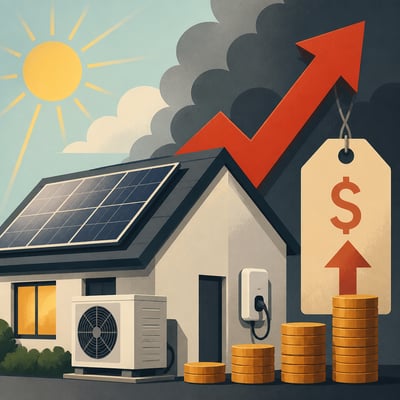
The expiration of major federal consumer clean-energy tax credits is reshaping U.S. household technology markets, with rooftop solar and related battery installations facing weaker demand, higher consumer costs, and industry restructuring. Electric vehicle spending has also fallen sharply, while heat pump sales have continued to rise despite the loss of incentives. The pattern suggests that policy support remains important for some technologies, but established demand, financing models, and perceived household value are sustaining adoption in others.

First Article: 01/11/26

Latest Article: 07/16/26

Summary

  • Rooftop solar installations are projected to fall in 2026 after the 30% homeowner tax credit expired, with companies cutting jobs, exiting markets, and restructuring.
  • Higher system costs and longer payback periods are pushing installers toward third-party ownership, subscriptions, and other financing models.
  • U.S. home battery additions are also expected to decline, although battery attachment among new solar systems is rising.
  • Heat pump sales continued to outpace natural-gas furnaces in early 2026 despite the expiration of their federal tax credit.
  • EV consumer spending dropped substantially after the $7,500 federal credit ended, though broader weakness in vehicle sales may also be contributing.
  • Homes explicitly marketed with rooftop solar or heat pumps have shown measurable sale-price premiums, but energy features remain inconsistently disclosed in listings.
  • California and Florida are identified as exceptions to the broader U.S. residential solar downturn.

History

07/23/2026

The story now adds that EV consumer spending has fallen sharply after the $7,500 federal credit ended, broadening the impact beyond solar and batteries. It also tightens the framing around financing adaptation and clarifies that California and Florida remain exceptions to the national solar downturn.

07/22/2026

The story has sharpened from a broad post-credit adjustment into a more specific market divergence: rooftop solar, batteries, and EV demand are weakening sharply, while heat pumps remain comparatively resilient and home-energy value is showing up in resale data. The current version also adds clearer evidence of industry restructuring and state-level divergence, especially in California and Florida.

Full History

Featured

Timeline: 187 Days

Jan 11Feb 22Mar 22May 3May 31Jul 12

Additional Articles

⭐⭐⭐⭐⭐

Canary Media05-29-2026
In the United States, federal EV tax credit phaseout ended in September 2025, and EV spending fell sharply through late 2025 per Clean Investment Monitor data.
Jasper Local / Andrea Ziegler01-25-2026
In 2026, a Jasper, Alberta homeowner outlines how Alberta's CEIP financing and solar micro-generation rules affect planning rooftop systems and potential heat pump upgrades.
Boulder Daily Camera / Todd Woody01-14-2026
In 2026, U.S. industry representatives explain that the expiration of federal heat pump tax credits and ongoing tariffs will slightly increase residential system costs nationwide.

⭐⭐⭐

Bloomberg / Ishika Mookerjee06-16-2026
BloombergNEF projects lower US new residential rooftop solar installations during the 2020s while research reports variable coral reef resilience to climate change.
MIT Technology Review / Casey Crownhart07-16-2026
Lucas Davis analyzed Air Conditioning, Heating, and Refrigeration Institute shipment data showing US heat pump sales outpaced gas furnaces in early 2026 despite tax credit expiration.
The Cool Down / Shannon Germaine06-23-2026
257 reports 2024 to 2025 U.S. home sales show rooftop solar and ducted heat pumps sell for about 1% to 2% more, though listings often omit upgrades.
The Independent03-24-2026
The UK government plans Future Homes Standard rules for heat pumps and onsite solar, plus discounted windy-day bills in Scotland and the East of England to reduce wind curtailment.
Heatmap / Robinson Meyer07-02-2026
United States solar and wind tax credits end July 4, with permitting reform and global Q2 electric-vehicle sales trends highlighted for clean energy developments.
Union Democrat / Justin Sullivan01-12-2026
U.S. homeowners face higher electrification costs in 2026 as federal solar, battery, and heat-pump tax credits expire and domestic-content rules take effect nationwide.
HeatPumpsAndSolar.co.uk / Mark Anthony Haines03-31-2026
In the UK during Q2 2026, analysts anticipate the Ofgem price cap will rise after April's 1641 baseline, affecting household solar, battery, and heat pump adoption.
CKPG Today01-24-2026
Canada forecasts 2026 to be among the hottest years on record, with government clean energy investments and emissions policies.
Advanced Energy United / Kate Shonk01-15-2026
State legislatures and utility regulators in 2025 expanded heat pump grants, geothermal networks, and VPP pilots to accelerate electrification and grid flexibility.
Heatmap Daily07-02-2026
July 4 ends U.S. solar and wind tax credits, while second-quarter global EV sales data show year-over-year gains for major automakers.

⭐️⭐️

Energy Live News / Sumit Bose02-05-2026
UK home buyers are willing to pay more for solar panels and heat pumps as the Future Homes Standard moves toward 2027.
Twin Cities / Todd Woody01-14-2026
In 2026, the removal of heat pump tax credits and new tariffs are expected to raise heat pump prices in the United States.
Hastings Tribune01-11-2026
US homeowners face higher costs in 2026 as federal tax credits end and tariffs raise prices for solar panels, batteries, and heat pumps.
ArcaMax / Todd Woody01-11-2026
U.S. policy changes in 2026 raise costs for residential electrification nationwide.
MarketBeat02-01-2026
MarketBeat identifies five solar stocks to watch on February 1 2026, highlighting incentives and costs as drivers across the United States, France, Japan, and Chile.
Yahoo Shopping / Catherine Wilkins01-18-2026
Baltimore residents faced rising utility bills in 2025 due to policy changes and aging infrastructure in the Mid-Atlantic region.