
 Climate
 Privacy
 Bob Dylan
 Drones
 Data Centers
 AI Governance
 2026 Maine Senate Race
Extreme Heat Strains India’s Workers
Coverage from The Guardian, Inside Climate News, and others
00/00/0000
Articles
52
Active Days
162
The Topic
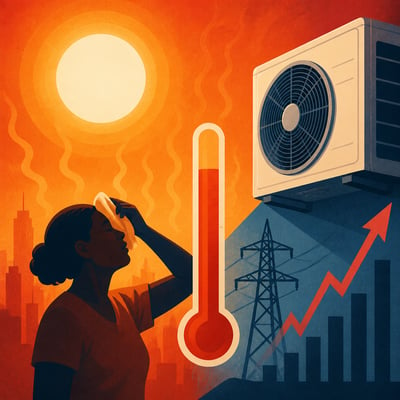
More frequent and severe heat is exposing major vulnerabilities across India and South Asia, with outdoor and informal workers facing illness, lost wages, dehydration and potentially longer-term kidney and cardiovascular risks. Heatwaves are also straining hospitals, electricity supplies, water access and urban infrastructure, particularly in densely populated and lower-income communities. The evidence points to practical adaptation needs including shade, rest, drinking water, heat alerts, cooling facilities and stronger workplace protections, while expanded cooling can increase electricity demand if not paired with lower-emissions power.
First Article: 02/16/26
Latest Article: 07/27/26
History
The story broadens from worker heat harms to a wider systems strain: heat is now framed as stressing hospitals, electricity, water access and urban infrastructure as well as livelihoods. The update also adds a sharper adaptation focus on practical protections and lower-emissions cooling.
The story now places much greater emphasis on worker livelihoods and concrete vulnerability factors, while expanding beyond India to include Pakistan’s Karachi heat impacts. It also more explicitly frames cooling as a tradeoff with electricity demand and emissions.
- April–May 2025 South Asian heatwave is now explicitly referenced.
- Pakistan, especially Karachi, is newly included in the story.
- Income losses and missed workdays are newly quantified for Indian informal workers.
- Workplace vulnerabilities now include sanitation and medical support gaps.
- Air-conditioning growth is linked to fossil-fuel generation pressure.
The story narrows from a broader India-Europe heat and power-systems narrative to a more India-specific account centered on quantified health, labor, and economic losses. New research sharpens the framing around adaptation gaps, cooling demand, and water-food stress.
- Story focus shifts away from Europe to India-only heat impacts.
- New research quantifies economic and health losses from extreme heat.
- Health impacts now include higher cardiovascular risk.
- IIED and UC Berkeley India Energy and Climate Center are new actors.
- Adaptation measures are specified more concretely.
The story has broadened from India-centered heat stress to a wider, more operational energy-system narrative that now explicitly includes Europe and grid reliability impacts. It also adds stronger forward-looking analysis, with forecasts and long-run projections extending the issue beyond observed heat events.
- Europe now appears as a distinct heat-stress region.
- Heat is linked to transmission equipment stress and curtailments.
- Forecasts now extend to 2035 and 2050.
- Many households still lack air conditioning.
- Trend data now spans roughly 1961 to 2025.
The story now frames India’s heat problem less as a broad climate-risk narrative and more as an adaptation and systems-management challenge, with stronger emphasis on health impacts, labor exposure, and lower-emissions cooling. It also adds a clearer regional dimension by explicitly tying India’s conditions to the wider South Asia heatwave, including Pakistan.
The story has broadened from India-specific heat risk into a more explicit adaptation-and-systems problem, with stronger emphasis on power grids, water and agriculture, and a new secondary thread about Canadian heat-health planning. The current version also adds new institutional actors focused on that Canada-related guidance.
The story has sharpened from a broad account of repeated heat crises into a more specific picture of escalating, longer-duration heat in India, with stronger emphasis on nighttime heat, humidity, and system-wide strain. The frame also shifts toward incomplete adaptation and resilience gaps, especially for workers, households, and the power system.
The story now puts more weight on undercounted mortality and a broader adaptation response, with new emphasis on heat-response systems, cooling technologies, and insurance rather than just general preparedness. It also sharpens the framing around seasonal drivers like monsoon timing, El Niño, and rainfall deficits as structural amplifiers of heat risk.
The story now places much greater weight on adaptation in motion, showing governments and communities actively testing responses such as heat action plans, cooling gear, cool roofs, and livestock protections. It also sharpens the operational weakness: governance, warning coverage, and heat-death counting are still incomplete even as the heat threat remains elevated.
- Heat action plans, relief vans, cool roofs, and cooling gear are being tested.
- Livestock insurance and ventilation appear as adaptation measures.
- Heat-death counting and warning coverage remain incomplete.
- Dairy cattle impacts are now a distinct focus.
- Heat is framed as a cross-sector climate risk.
The story has broadened from recurring South Asia heat extremes to a more explicit climate-attribution and systems-resilience frame. The new version emphasizes that warming is making heatwaves longer, more humid, and more frequent, while adaptation now includes energy and grid responses, not just public-health measures.
The story shifts from a general account of extreme heat risks to a more developed picture of recurring, record-level heat as a structural seasonal threat across South Asia. The current version adds clearer emphasis on undercounted deaths, broader secondary impacts like crop and water stress, and the persistent gap between adaptation plans and implementation.
Extreme heat across India and neighboring South Asia is intensifying health, labor, and electricity risks. Recent heat waves, attribution studies, and forecasts all point to hotter, more frequent events that outpace current adaptation capacity.