History
07/23/20260 new articles
The story now places greater emphasis on the scale of the supply shock and on China’s specific tools for cushioning it, while sharpening the link to faster but uneven clean-energy and EV adoption. It also makes the agricultural and food-security consequences more explicit and immediate.
07/22/20260 new articles
The story has shifted from broad disruption and price volatility to a more specific emphasis on household, food-security, and transport impacts, with China identified as a key stabilizing factor in oil markets. It also now foregrounds a clearer behavioral response: cleaner energy, EVs, and resilient agriculture as direct adaptations to the shock.
- China’s reserves and clean-energy growth are limiting the oil-price spike.
- Fertilizer shocks may worsen hunger and poverty in import-dependent regions.
- Some markets are seeing reduced demand for gasoline-powered transport.
- Cleaner, more local food and energy systems are gaining renewed attention.
07/20/20263 new articles
The story is now framed more sharply around Hormuz-linked attacks on energy infrastructure and shipping, not just price volatility, with added emphasis on downstream fertilizer/LPG stress and conflict-emissions estimates. It also broadens slightly into a more explicit country-divergence narrative across Asia, Europe, the Middle East, and the United States.
06/19/20263 new articles
The update sharpens the framing around Strait of Hormuz disruption as the central energy-security shock and makes the U.S. policy angle more explicit, with the Trump administration now presented as actively favoring fossil fuels over renewables. It also broadens the downstream effects to emphasize divergent country outcomes, especially exporters versus importers.
06/06/20263 new articles
The story has broadened from a general conflict-and-energy shock into a more specific Strait of Hormuz disruption affecting shipping, fertilizer, and food systems, with a clearer climate-security framing. It also adds Iran’s water stress as a separate but related climate impact thread.
05/21/20262 new articles
The framing broadens from a Strait of Hormuz energy-shock story into a more explicit climate-policy and technology-transition story. The biggest new element is the separate U.S. policy rollback under the Trump administration, which adds a second pressure point on clean-energy momentum.
05/11/2026Topic Formed
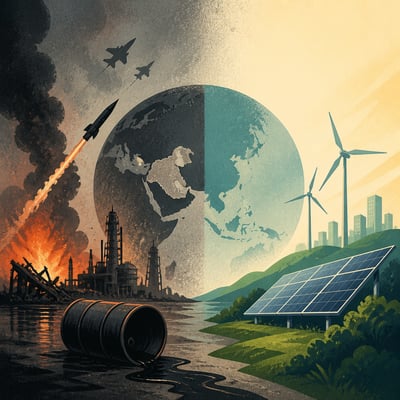
Recent coverage links Iran-related conflict around the Strait of Hormuz to oil, gas, fertilizer, and shipping disruptions that raise prices and emissions while pressuring governments to accelerate renewables, protect consumers, and manage short-term coal and fossil-fuel substitution.

 Climate
 Privacy
 Bob Dylan
 Drones
 Data Centers
 AI Governance
 2026 Maine Senate Race