The Guardian / Heather Stewart05-03-2026
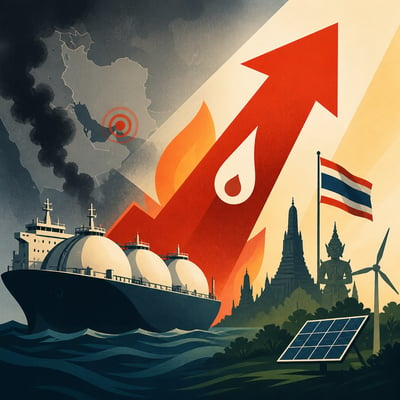
The International Energy Agency links Iran-war fuel-price and supply risks to emergency clean energy actions in nearly 40 countries, accelerating renewables, batteries, and electric vehicles.
 NPR / Julia Simon07-09-2026
Middle East conflict and Strait of Hormuz LNG disruption drive higher fossil fuel prices, leading multiple Asian and African countries to expand solar, batteries, and EV deployment.
 Mother Jones / Amy Hawkins07-01-2026
China was assessed as most insulated in Asia from the Strait of Hormuz energy shock after the waterway’s near-closure following US and Israeli strikes.
 Insurance Journal05-01-2026
UNFCCC climate officials and government leaders cite Iran-war oil and gas disruptions as a driver of renewables deployment and electric vehicle growth while some countries increase coal use, amid fossil fuel phaseout talks in Colombia.
 Newsday05-13-2026
Higher fuel costs after the Iran war increase rooftop solar installations in the Philippines during February to April, while China expands solar exports across Asia and Africa.
 Financial Post05-15-2026
Energy Transitions Commission cites the Iran conflict as a driver for faster renewable and storage investment due to reduced exposure to fossil supply disruptions.
 Axios / Ben Geman04-16-2026
BloombergNEF, Wood Mackenzie, and other analysts report that rising energy prices tied to conflict are changing generation fuel economics, with some coal rebounds and faster cleantech momentum in multiple countries.
 Semafor05-26-2026
BloombergNEF projects oil demand plateaus in the early 2030s while natural gas demand rises through mid-century, and clean energy investment must double for net zero by 2050.
 E&E News by POLITICO05-14-2026
Amid Iran war-driven oil disruptions, Chinese EV, solar, battery, and wind exports have risen as countries pursue energy security during trade talks in Beijing.
 WWNO07-09-2026
Multiple countries in Asia and Africa increased solar, batteries, and electric vehicle adoption after conflict-driven oil and LNG supply disruptions raised prices and risk.
 WTOP05-13-2026
After the Iran war began in late February, fuel-price spikes in the Philippines increased rooftop solar installations and inquiries while Chinese solar exports rose in March.
 Boise State Public Radio07-09-2026
Energy security pressures from Middle East oil and LNG disruptions are pushing Asia and Africa to deploy solar, batteries, and electric vehicles, supported by Chinese exports.
 Aspen Public Radio07-09-2026
During Middle East conflict-related fuel disruptions, countries in Asia and Africa accelerate solar, batteries, and electric vehicle adoption to reduce imported oil and natural gas dependence.
 News Gazette05-13-2026
Fuel price increases from the Iran war since Feb. 28 boosted rooftop solar installations and inquiries in the Philippines, alongside record Chinese solar exports in March.
 Hjnews05-13-2026
After the Feb. 28 start of the Iran war, higher fuel costs increased rooftop solar installations in the Philippines while China boosted clean technology exports in March.
 Energy Connects05-15-2026
Energy Transitions Commission executives including Adair Turner cite Iran-linked oil disruptions as rationale for faster renewable deployment in energy-transition investments.
 ETEnergyworld.com04-27-2026
Analysts link Iran war-driven fuel price shocks to larger European power price increases in gas-dependent systems and greater stability in renewable-heavy Albania.
 Global Renewable News05-28-2026
The IEA forecasts $3.4 trillion in global energy investment for 2026, citing Hormuz Strait closure risks that redirect spending toward grids, storage, and low-emissions capacity.
 POLITICO04-19-2026
After the Iran war, Europe and Asia accelerate clean-energy electrification, while China-dominated solar, battery, EV, and wind supply chains raise security and trade concerns.
 Cision PR Newswire05-14-2026
Energy Transitions Commission flags that Hormuz-related fossil price volatility increases energy security risks and recommends accelerating renewables and electrification.
 Toda Peace Institute / Abdullah Fahimi07-09-2026
Following US-Iran interim talks and continued regional disruptions, countries in 2026 accelerated electrification and renewable deployment to reduce fossil fuel import risk.
Semafor05-04-2026 Qatar helium shutdown and Iran-linked supply disruptions in Bahrain and the UAE raise aluminum and semiconductor input costs for solar and wind manufacturing as oil prices remain volatile.
 Time05-29-2026
Mahindra Group accelerates resort kitchen electrification in Asia as the IEA world energy investment report cites reduced fossil fuel import costs from electrification and efficiency.
 South China Morning Post / Martin Brownbridge04-12-2026
Asian governments in the 2020s implemented fuel-tax suspensions and subsidy programs after Gulf supply shocks raised fuel prices, while energy transition toward renewables accelerated.
 Fortune04-23-2026
Energy transition investment growth is framed as resilience against geopolitical oil chokepoint risk centered on the Strait of Hormuz.
Semafor06-19-2026 Meghan O'Sullivan and Richard Goldberg discuss how US-Iran de-escalation could affect oil transit through the Strait of Hormuz while electrification reshapes energy security decisions.
 The Week / Joel Mathis04-16-2026
Europe and Asia are shifting faster toward Chinese-made solar, batteries, wind equipment, and grid infrastructure as Strait of Hormuz oil shocks affect energy security amid the U.S.-Iran conflict.
 Acuity Law06-16-2026
IRENA, through a 24/7 renewables report, says battery storage cost declines support round-the-clock solar and wind power to improve energy security amid Strait of Hormuz disruptions.
 Sierra Magazine05-03-2026
International Energy Agency said a Hormuz-related supply disruption amid the US-Israel war against Iran drove fuel and fertilizer price increases while renewables costs fell.
 Talking Points Memo05-06-2026
Geopolitical disruptions near the Strait of Hormuz are driving energy policy changes worldwide, with renewables, batteries, EVs, and nuclear investment expanding as fossil exposure falls.
 Council on Foreign Relations04-16-2026
During the Iran war and Strait of Hormuz disruption, countries dependent on Middle East oil and LNG accelerate renewable, battery, and EV adoption while China expands grid and clean-energy supply.
 The American Prospect / Ryan Cooper04-15-2026
After Strait of Hormuz disruption and US subsidy rollbacks for solar, wind, and EVs, multiple countries see renewed renewables and EV demand while some shift toward coal and face fertilizer-driven food risks.
 Asia Asset Management04-28-2026
IEA executive director Fatih Birol said Middle East conflict and the Strait of Hormuz standoff will drive durable renewables and nuclear policy shifts worldwide.
 Salon05-16-2026
The International Energy Agency described Iran-linked conflict as a major oil supply disruption, prompting countries in late-April Colombia talks to accelerate renewable energy and electrification.
 ctech / Shani Ashkenazi05-10-2026
The International Energy Agency describes the Hormuz crisis as a major oil-supply disruption in March, driving transport demand cuts and renewables and EV acceleration policies across multiple countries.
 Informed Comment / John Feffer06-08-2026
Iran war disruptions around the Strait of Hormuz are linked to higher global fossil-fuel costs, influencing energy transition decisions in the US, China, and Japan.
 Greenpeace05-12-2026
Renewables with battery storage and grid flexibility are presented as a way to reduce fossil-fuel-linked electricity price spikes during geopolitical disruptions.
 The Invading Sea / Ezgi Canpolat04-04-2026
War disruptions near the Strait of Hormuz in the Middle East have raised oil prices, driving different renewable energy transition pathways across exporting and importing countries.
The Invading Sea / Sonali Kolhatkar04-07-2026 Renewable energy transition is argued to reduce fossil-fuel geopolitics and economic disruption, alongside national and regional climate impacts, in contrast to reported US offshore wind rollback.
 The Independent03-20-2026
Oil and LNG export disruption through the Strait of Hormuz escalated fuel costs in Asia, Europe, and Africa, increasing pressure for faster renewable energy deployment and electrification.
 Forbes / Ken Silverstein03-31-2026
Iran conflict intensified exposure of oil and LNG chokepoints, and renewable deployment is presented as a resilience and price-stability strategy alongside critical-mineral supply-chain upgrades.
 AP News03-20-2026
An AP report in March 2026 links Iran conflict-driven Strait of Hormuz oil and LNG disruption to higher energy prices and renewed momentum for renewable energy deployment across Asia, Europe, and Africa.
Fortune / Tristan Bove04-01-2026 The International Renewable Energy Agency reports record renewable growth as Strait of Hormuz disruptions spur electrification and conservation in Asia and Europe.
 Legal Planet / Dan Farber05-18-2026
Iran war is credited with accelerating solar, wind, and EV adoption outside the United States through renewed energy security and market-shifting effects.
 AOL04-17-2026
Rising oil prices from Strait of Hormuz disruption in 2026, amid US-Iran tensions, may accelerate renewable deployment and reinforce China’s clean-energy manufacturing lead.
 SEJ03-27-2026
Amid US-Israeli strikes on Iran and Strait of Hormuz supply disruption, commentary highlights that wind and solar generation is less affected by fossil fuel price volatility after build-out.
 Sustainable Energy for All04-07-2026
IEA emergency reserves totaling 400 million barrels are authorized after Strait of Hormuz disruption, while clean energy scaling and Africa electricity-access programs are highlighted amid record heat.
 Oil Change International / Valentina Stackl05-28-2026
The IEA World Energy Investment report projects rising fossil fuel investment and stagnant clean energy investment amid geopolitical instability and energy price volatility.
 Newstarget07-03-2026
Tilak Doshi links Strait of Hormuz disruption to fossil fuel price shocks and argues LCOE-based renewable comparisons omit grid and intermittency costs.

 Climate
 Privacy
 Bob Dylan
 Drones
 Data Centers
 AI Governance
 2026 Maine Senate Race