
Last Update: 08/01/2026 at 2:00 PM EST

Marine Heat Waves Disrupt Ocean Recovery

Coverage from Nature, Yale E360, and others

Articles

16

Active Days

1434

The Topic
Marine Heat Waves Disrupt Ocean Recovery topic image

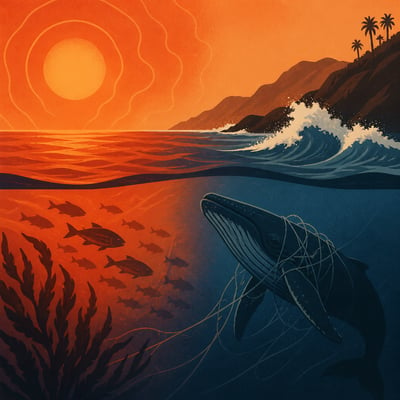
Ocean warming and persistent marine heat waves are intensifying pressure on kelp forests, seagrass restoration projects, seabirds, and other marine food webs. The reporting also indicates that warming can reduce the ocean’s long-term carbon storage capacity, with the balance of mechanisms varying by emissions pathway. Restoration groups are expanding monitoring, species selection, predator recovery, and heat-tolerant cultivation, but extreme temperatures and continued emissions growth remain major barriers.

First Article: 08/18/22

Latest Article: 07/21/26

Summary

  • Persistent marine heat waves are disrupting California coastal ecosystems and contributing to seabird starvation by shifting fish prey into deeper or cooler waters.
  • Kelp forests are declining under combined pressure from warming, urchin overgrazing, pollution, and bottom trawling.
  • A rapid marine heat wave coincided with failure of a major seagrass planting effort in North Wales, highlighting the importance of heat-risk screening in restoration planning.
  • Restoration responses include urchin removal, predator recovery, kelp biobanks, selective breeding, replanting, and satellite, drone, and AI-supported monitoring.
  • Ocean warming is projected to reduce marine carbon storage, and the dominant mechanisms differ according to the emissions pathway.
  • El Nino and atmospheric conditions can amplify or prolong regional marine heat waves, increasing uncertainty around ecological and coastal-weather impacts.

History

07/23/2026

The story now places greater emphasis on ocean warming as a carbon-cycle problem, not just a habitat and restoration problem. It also adds a new ecological driver—El Nino and atmospheric conditions—as factors that can intensify marine heat waves and increase uncertainty.

07/22/2026

The story has broadened from kelp and whale impacts to a wider coastal-ecosystem narrative, adding seagrass restoration failure in North Wales and seabird starvation in California. It also shifts from describing adaptation experiments in general to showing specific restoration tactics being tested against recurring marine heat extremes.

Full History

Featured

Timeline: 1434 Days

2022Jan 1Mar 5May 28Jul 30Oct 22Dec 242023Jan 1Mar 5May 28Jul 30Oct 22Dec 242024Jan 1Mar 4May 27Jul 29Oct 21Dec 232025Jan 1Mar 5May 28Jul 30Oct 22Dec 242026Jan 1Mar 5May 28Jul 30Oct 22Dec 24

Additional Articles

⭐⭐⭐⭐⭐

Grist / Richard Schiffman06-21-2026
Scientists report kelp forest declines off British Columbia and California as ocean warming drives habitat loss, while restoration teams in Australia and globally test modeling, breeding, and urchin control.
AP News07-01-2026
NOAA and Scripps researchers linked a California seabird die-off to a persistent marine heat wave, with strengthening El Nino expected to sustain warm coastal waters.
Phys06-26-2026
A north Wales seagrass restoration project reported seagrass seedling failure at Bae Tremadog during a rapid-onset marine heat wave in 2023-2024.
AOL04-11-2026
NOAA researchers reported that marine heat waves increase rapid intensification and about 60% higher billion-dollar hurricane damage at landfall based on 1,600 storms since 1981.
Ecomagazine06-09-2026
University of Victoria researchers report northern Salish Sea bull kelp loss between 1972 and 1984, tied to sustained regional warming near Vancouver Island.
Mercury News / Paul Rogers06-15-2026
Researchers reported domoic-acid poisoning in two humpback whales washed ashore near Pacific Grove and Watsonville as El Niño-driven warming increases harmful algae bloom risk.
Springer Nature04-08-2026
A climate modeling and observation study projects faster late-century marine warming and more extreme marine heatwaves across 19 enclosed seas, including the Mediterranean and Gulf of Mexico.
The Guardian02-25-2026
Researchers analyze northern hemisphere marine populations from 1993 to 2021 to show chronic ocean warming reduces fish biomass across basins.
The Guardian04-03-2026
Scripps Institution of Oceanography reports record coastal water-temperature highs in California during a high-pressure-driven marine heatwave affecting upwelling and marine ecosystems.
Inside Climate News / By Teresa Tomassoni02-25-2026
NOAA researchers report habitat compression during recent marine heatwaves along the California coast, causing increased humpback entanglements with fixed gear.
Frontiers / Laura Rogers-Bennett08-18-2022
Researchers describe how 2014–2016 marine heatwaves in northern California caused kelp forest collapse and the 2018 closure of the red abalone fishery.
Mongabay / Morgan Erickson-Davis01-13-2026
Researchers track vessel movements on the U.S. West Coast from 2010 to 2024 to detect marine heat wave driven fish distribution shifts.

⭐⭐⭐

University of Vermont07-21-2026
Daniel Sadler at the University of Vermont studies how warming oceans and predator declines are reshaping kelp forests into urchin barrens along California and Oregon.