History
07/23/20260 new articles
The story now places greater emphasis on ocean warming as a carbon-cycle problem, not just a habitat and restoration problem. It also adds a new ecological driver—El Nino and atmospheric conditions—as factors that can intensify marine heat waves and increase uncertainty.
07/22/20262 new articles
The story has broadened from kelp and whale impacts to a wider coastal-ecosystem narrative, adding seagrass restoration failure in North Wales and seabird starvation in California. It also shifts from describing adaptation experiments in general to showing specific restoration tactics being tested against recurring marine heat extremes.
- Seabird starvation was linked to prey shifting deeper or farther offshore.
- A North Wales seagrass planting failed at one site after rapid warming.
- A cooler nearby site still supported seagrass seedling establishment.
- Restoration projects are testing heat-tolerant kelp strains and remote sensing.
- Marine carbon storage is now tied to emissions pathway sensitivity.
07/01/20263 new articles
The story broadens from general Pacific-coast marine heatwave impacts into a more specific picture of how chronic warming is driving kelp restoration challenges, whale entanglement risk, and fisheries losses. It also adds new operational and forecasting actors, suggesting adaptation is becoming more technical and management-focused.
06/16/20263 new articles
The story broadens from a California-centered marine heatwave narrative into a wider climate-risk picture that more explicitly includes fishery management, wildlife mortality, and storm damage. It also adds clearer evidence of active response through monitoring and restoration efforts.
05/30/20260 new articles
The story has shifted from broadly describing marine warming impacts to emphasizing a more operational, evidence-backed response: agencies and researchers are now actively tracking heat effects and testing management tools. The current version also adds stronger claims about chronic seabed heating and explicitly broadens the hazard link to coastal disaster damage and hurricane intensification.
05/12/2026Topic Formed
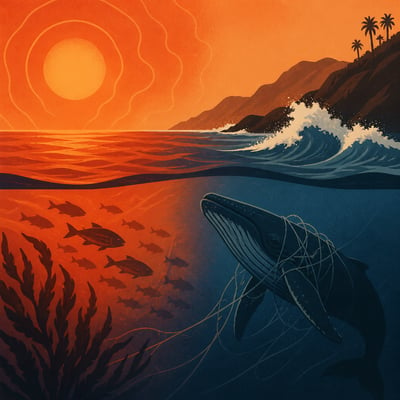
Recent coverage shows marine heatwaves and persistent ocean warming becoming a recurring operational risk along the California coast and other enclosed or coastal seas. The strongest evidence ties warming oceans to ecosystem disruption, fishery shifts, whale entanglements, and higher storm damage, while forecasting and mitigation tools are still developing.

 Climate
 Privacy
 Bob Dylan
 Drones
 Data Centers
 AI Governance
 2026 Maine Senate Race