
 Climate
 Privacy
 Bob Dylan
 Drones
 Data Centers
 AI Governance
 2026 Maine Senate Race
Last Update: 08/01/2026 at 2:00 PM EST
Methane Surge And Atmospheric OH
Coverage from Science, Geophysical Fluid Dynamics Laboratory, and others
Articles
7
Active Days
161
The Topic
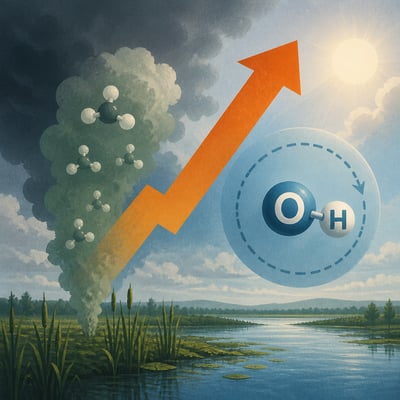
Recent research points to a global methane surge driven mainly by weaker atmospheric removal through hydroxyl radicals, with wetter conditions raising wetland and inland-water emissions. A second thread examines how warming may change OH chemistry and methane lifetime.
First Article: 02/05/26
Latest Article: 07/15/26
Summary
- The strongest signal is a re-interpretation of the early-2020s methane jump: reduced OH removal appears to explain most of the increase.
- Climate variability, especially La Niña-associated wetness, repeatedly shows up as a driver of higher emissions from wetlands, inland waters, and rice systems.
- Fossil-fuel and wildfire contributions are described as secondary in the surge, although source attribution remains model-dependent.
- Methane growth slowed in 2023, suggesting the surge was not a simple one-way acceleration but a phase linked to shifting atmospheric and hydrologic conditions.
- Models appear to underrepresent flooded-ecosystem methane emissions and their variability, especially in tropical Africa, Southeast Asia, and Arctic regions.
- A separate modeling thread asks how warming itself will change OH, with competing effects from water vapor and biogenic VOCs producing a small net gain in methane oxidation capacity.
- The topic is coherent and fairly dense, but it contains two related layers: attribution of the recent methane spike and projection of future atmospheric chemistry responses.
History
The story is largely stable, but it now frames the methane surge more explicitly as a global phenomenon and slightly sharpens the modeling side of the OH question. The main update is a modest reframing of attribution rather than a new substantive development.
Featured
02-10-2026
Scientists show global methane variability from 2019 to 2023 driven by OH changes and emissions from wetlands, agriculture, and waste management.
07-15-2026
Researchers using CMIP6 AerChemMIP Earth system models reported that future warming and air-pollution changes alter OH concentrations, affecting methane lifetime.
03-24-2026
MIT researchers modeled tropospheric hydroxyl radicals with AquaChem and found a small net change in methane-oxidation capacity under a +2 C warming scenario.
Timeline: 161 Days
Hover over any logo to see coverage summary, click for full article.
Additional Articles
⭐⭐⭐⭐⭐⭐⭐⭐
An international team led by LSCE scientist Philippe Ciais reported in Science that pandemic-era chemistry and climate shifts drove the 2020–2022 global methane spike.
A February 2026 Science study on global methane trends provides climate context but includes no analysis of heat pump technologies or policies.
⭐⭐⭐⭐⭐
Researchers report a weakened hydroxyl sink and climate driven wetland emissions raised global methane levels from 2019 to 2023.
⭐⭐⭐
MIT modeled hydroxyl radical OH under 2 degrees Celsius warming, estimating a small net OH increase that alters methane lifetime and ozone chemistry.