
 Climate
 Privacy
 Bob Dylan
 Drones
 Data Centers
 AI Governance
 2026 Maine Senate Race
Federal Plans to Break Up NCAR
Coverage from Inside Climate News, The Hub, and others
Articles
7
Active Days
67
The Topic
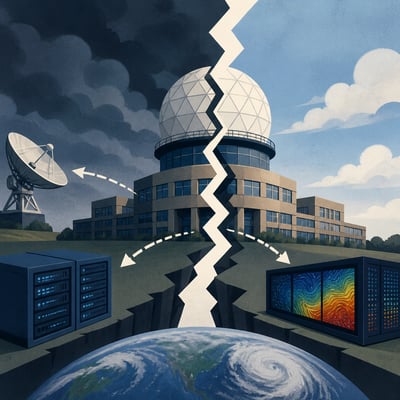
The Trump administration and the National Science Foundation are pursuing a restructuring of the National Center for Atmospheric Research, including possible transfers of its facilities, supercomputing resources, aircraft, and research programs to other organizations. Scientists, lawmakers, universities, and Colorado business leaders warn that breaking up NCAR could disrupt weather forecasting, hazard research, shared research tools, and the training of atmospheric scientists. The central dispute is whether NCAR's capabilities can be preserved through fragmentation or depend on remaining an integrated national research center.
First Article: 03/11/26
Latest Article: 05/16/26
Summary
- NSF has solicited proposals to assume parts of NCAR's infrastructure, equipment, and research portfolio.
- Potentially affected assets include the Mesa Laboratory in Boulder, the Derecho supercomputer in Wyoming, research aircraft, and specialized programs.
- Researchers say NCAR's shared models, computing, observations, and technical staff support forecasting of hurricanes, wildfire smoke, floods, and other hazards.
- Universities, scientific groups, lawmakers, and Colorado business leaders are calling for a transparent review before any breakup proceeds.
- Critics warn that fragmentation could disrupt collaboration, data continuity, public forecasting tools, and the atmospheric-science training pipeline.
- The future ownership and management of several NCAR facilities and programs remains undecided.
History
The story is slightly reframed from a broad warning about NCAR fragmentation to a more specific dispute over whether its capabilities can survive breakup, with the proposal timeline now better defined. The current version also adds Colorado business leaders and universities as active stakeholders pressing for review.
The story now frames NCAR restructuring as a broader dismantling effort with more explicit attention to transferring research functions and the unresolved oversight process. It also adds stronger emphasis on stakeholder concern about preserving integrated scientific capabilities and training.
Featured
Timeline: 67 Days
Hover over any logo to see coverage summary, click for full article.