History
07/23/20260 new articles
The main update is a sharper emphasis on near-term demand pressure and the policy battle around emissions rules. New Mexico’s clean-energy buildout remains intact, but the revised version adds stronger evidence that load growth is accelerating and that opposition is now explicitly centered on oil and gas and allied groups.
07/22/20260 new articles
The biggest change is that New Mexico’s transition now clearly includes substantial new gas buildout alongside clean energy, driven by surging demand from data centers, manufacturing, and Permian electrification. The policy story also sharpened around carbon offsets, which have become a central compromise issue after greenhouse-gas targets again failed to advance.
- Utilities plan substantial new gas capacity for projected demand growth.
- Data centers, manufacturing, and Permian electrification are driving load forecasts.
- Carbon offsets are now a central policy compromise issue.
- Environmental groups question offsets' reliability and enforcement.
- Greenhouse-gas target legislation failed in the 2026 session.
07/22/20260 new articles
The story now places more emphasis on New Mexico’s climate-policy debate: the 2026 bill failure is reframed around contested use of offsets and carbon capture, while the system buildout remains focused on reliability and demand growth. The current version also broadens the stakes to include wildfire, drought, water-supply, and pollution-related costs.
07/22/20262 new articles
The story now centers more explicitly on New Mexico’s electricity buildout meeting sharply rising demand, with regulators approving a large SPS resource plan that adds gas alongside renewables and transmission. That shifts the emphasis from broad climate-policy संघर्ष to the practical reliability and affordability tradeoff of serving industrial growth without deepening fossil dependence.
- PRC approved SPS’s major resource plan.
- SPS forecasts summer peak demand growth of about 40% by 2030.
- Renewables supplied 52% of utility power as of November 2025.
- New Mexico’s 2026 budget funds industrial decarbonization and clean-energy loans.
- Lawmakers reviewed more than $4 billion in climate-related spending and disaster costs.
05/18/20261 new articles
The story now looks more execution-oriented: New Mexico’s clean-energy and grid investments are moving forward, while the unresolved fight over statewide emissions targets is still the main political bottleneck. The framing also sharpens around fiscal exposure, with insurance, fire recovery, and water-security costs more explicitly tied to climate policy.
05/11/2026Topic Formed
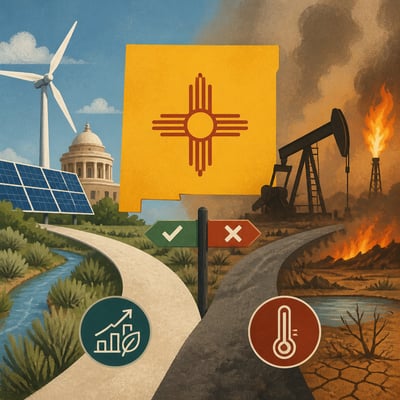
The cluster is centered on New Mexico’s active but uneven climate policy agenda: repeated attempts to codify greenhouse-gas targets, ongoing debate over offsets and enforcement, and simultaneous passage of narrower measures on methane, clean energy financing, grid modernization, and emissions data. The state’s climate debate is shaped by oil-and-gas dependence, budget tradeoffs, and rising evidence of climate costs from heat, drought, wildfire, and water stress.

 Climate
 Privacy
 Bob Dylan
 Drones
 Data Centers
 AI Governance
 2026 Maine Senate Race