
 Climate
 Privacy
 Bob Dylan
 Drones
 Data Centers
 AI Governance
 2026 Maine Senate Race
Plug-In Balcony Solar Gains Ground
Coverage from The Guardian, CNN, and others
00/00/0000
Articles
68
Active Days
182
The Topic
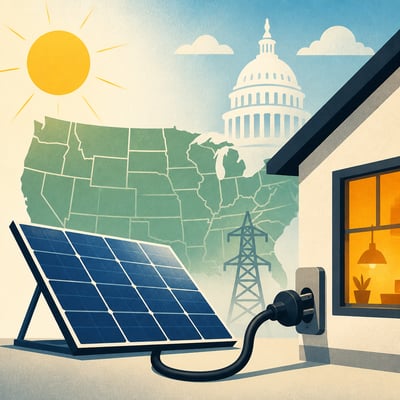
Plug-in balcony solar is moving from a niche European product toward wider adoption in the United States and potential retail availability in the United Kingdom, while Canadian access remains constrained by certification and electrical-code questions. Utah, Colorado, and New Jersey have taken steps to reduce permitting, utility, landlord, or homeowners association barriers, particularly for renters and apartment residents. The technology offers a lower-cost way to generate part of a household’s electricity, but broader uptake depends on consistent product standards, secure installation, and clear responsibilities for utilities and property owners.
First Article: 01/01/00
Latest Article: 07/08/26
History
The story now shows more concrete policy progress in the United States, with Utah, Colorado, and New Jersey advancing measures rather than just discussing access. It also tightens the UK and Canada picture: UK retail availability looks closer, while Canada is framed as still constrained by unresolved certification and electrical-code issues.
The story has broadened from a U.S. state-policy push into a wider commercialization and adoption picture spanning the UK, Canada, and Germany. The biggest new emphasis is that plug-in balcony solar is now being shaped not just by legislation, but also by retailer guidance, certification bottlenecks, and clearer consumer-market pathways.
- UK retailer guidance could bring balcony solar into mainstream consumer channels.
- Canada, especially Alberta, is now part of the story.
- Certification remains a key bottleneck in the U.S. and Canada.
- Germany now has more than one million reported balcony systems.
The story has broadened from a general push for plug-in solar legalization into a more concrete multi-state legislative effort with specific states, sponsors, and standards bodies now driving the agenda. UL Solutions and California's SB 868 now appear as central pieces of the policy push, making the issue feel more operational and immediate.
- California is now a prominent legislative site for balcony solar reform.
- Scott Wiener is identified as the sponsor of California's SB 868.
- New Jersey is cited for explicit plug-in solar limits and protections.
- UL Solutions now has certification and evaluation programs for plug-in solar safety.
- Utilities are negotiating legislation over shock, fire, and circuit-loading concerns.
The story is now more concrete: several states have moved from general legalization toward specific exemptions for small plug-in systems, while UL Solutions has provided a new safety certification reference point. The framing also shifts toward practical adoption for renters and households without roof access, with Germany remaining the main model and Illinois still a lagging case due to safety negotiations.
The story has moved from a Utah-led policy debate into a broader, more active state-level legislative push, with California, Illinois, and Vermont now showing concrete bill activity, delays, and enacted frameworks. UL Solutions is still central, but the new emphasis is on whether states will actually legalize and operationalize plug-in solar through utility exemptions and safety rules.
- Illinois legislation is stalling over safety and backfeeding concerns.
- Vermont S 202 creates a new plug-in solar framework with utility limits.
- California SB 868 is a major pending bill to expand balcony solar access.
- State efforts now explicitly involve utility-rule exemptions.
- UL Solutions is positioned as the main certification standard for plug-in systems.
The story has sharpened from broad legalization momentum into a more concrete policy template centered on Utah’s 1,200-watt cap and UL certification as the key gatekeepers for plug-in solar. The emphasis is now less on generic adoption and more on how state rules and safety standards will determine whether renters can actually use these systems at scale.
The biggest change is that plug-in balcony solar now appears to be moving from broad U.S. state-level legalization talk into more concrete execution, with named bills, an existing Utah law, and new retail guidance in the UK. The story also gains a more explicit commercial and institutional dimension through utility support and UL certification pathways.
- California SB 868 would exempt qualifying plug-in solar from interconnection requirements and fees.
- New York's SUNNY Act would legalize balcony solar with a 1,200-watt cap.
- The UK now has a government-retailer guidance initiative for plug-in balcony solar.
- Consolidated Edison supports New York's balcony solar legislation.
- UL Solutions is launching U.S. certification programs for plug-in solar systems.
The story has broadened from a few state-level efforts into a more clearly national regulatory movement, with new legislation, certification standards, and market-building activity making plug-in solar feel more like an emerging household product category. The biggest new wrinkle is the stronger role of UL Solutions and the sharper emphasis on formal safety certification as a prerequisite for wider adoption.
- New York and Pennsylvania now appear as active state policy fronts.
- California SB 868 is identified as a specific exemption bill.
- New York's SUNNY Act is named as pending balcony-solar legislation.
- UL Solutions is described as the main certification body.
- Supporters now cite payback periods of only a few years.
The story has shifted from general policy traction to a more concrete state-level regulatory pattern, with Utah now framed as the early template and Virginia added as another enacted example. The current version also places more emphasis on safety standards and utility protections as part of the legalization process.
The story has widened beyond U.S. state rule changes to include Canada and a clearer regulatory ecosystem around certification and code integration. It also shifts from a mainly policy-tracking story to one that emphasizes adoption readiness and market scaling conditions.
U.S. states are rewriting rules for plug-in balcony solar, with Utah, California, Maine, Colorado, and others moving to exempt small systems from full interconnection and permitting rules. Safety certification and utility concerns remain the main friction points.