History
07/22/20260 new articles
The story is mostly stable, but Singapore’s adaptation effort is now framed more explicitly as a regional resilience-and-finance platform, with slightly sharper emphasis on food security and renewable-energy links to energy security. The timeline is also clarified: the national adaptation plan is expected in 2027.
07/22/20260 new articles
The story now puts more emphasis on Singapore’s use of modelling and digital tools to operationalise adaptation, while broadening the financing angle to include carbon-market frameworks. It also reframes regional cooperation as a necessity for managing climate shocks across interconnected Southeast Asian supply networks.
07/22/20262 new articles
Singapore’s adaptation story has broadened from mainly heat, flood, coastal protection, and coordination into a wider national resilience agenda that now explicitly includes food security and supply-chain exposure. The regional angle also becomes more concrete, with new emphasis on climate finance and Singapore’s role as a hub for resilience and renewable-energy investment across Southeast Asia.
- Food security is now explicitly part of the adaptation agenda.
- Singapore imports more than 90 percent of its food.
- Ravi Menon is a new climate-diplomacy actor in the story.
- Temasek Holdings is newly tied to regional climate-finance efforts.
- Renewable energy is linked to energy security and resilience strategy.
05/19/20260 new articles
Singapore’s adaptation push is now more concretely defined around execution tools and financing, not just planning. The updated version adds specific implementation mechanisms, new funding detail, and a clearer regional financing agenda.
05/11/2026Topic Formed
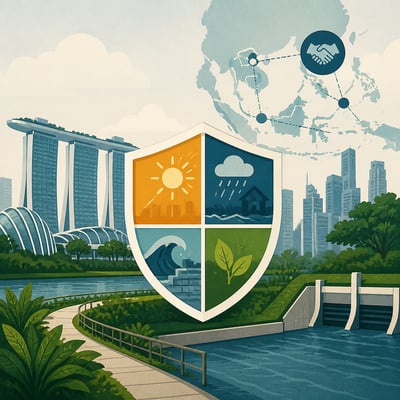
The cluster is centered on Singapore's move to accelerate climate adaptation through formal planning, dedicated institutions, and targeted infrastructure and financing measures. The dominant signal is a transition from general resilience discussion to implementation-oriented adaptation governance, with emphasis on heat, flooding, coastal protection, and regional cooperation. The narrative is coherent and current, with little historical drift.

 Climate
 Privacy
 Bob Dylan
 Drones
 Data Centers
 AI Governance
 2026 Maine Senate Race