History
07/23/20260 new articles
The story has shifted from a broad account of solar growth under policy headwinds to a clearer emphasis on how federal incentive cuts and China-related rules are now directly slowing U.S. investment and residential adoption. The updated version also sharpens the geographic split by highlighting Florida and California as relative outperformers.
07/22/20262 new articles
The story has broadened from a policy-and-financing squeeze on U.S. solar to a clearer picture of solar still growing strongly overall, even as tax-credit expirations and sourcing rules are starting to slow residential demand and utility planning. New data also adds a China-side slowdown, making the market shift look more global and uneven than before.
- Solar reached 12.8% of U.S. electricity in May, exceeding coal.
- Solar and battery storage made up 91% of first-quarter new U.S. generating capacity.
- U.S. residential solar is projected to fall 15% in 2026 after tax credit expiration.
- China's 2026 solar installations have dropped sharply after support reforms.
- Florida utilities have trimmed longer-term solar plans.
06/29/20260 new articles
The story has shifted from broad solar cost and deployment pressure to a more specific policy crackdown on China-linked ownership and control in subsidized U.S. solar projects. The biggest new wrinkle is that incomplete Treasury guidance is delaying clarity, while financiers and installers are already adjusting behavior.
- China-linked effective-control ties are now a central subsidy compliance risk.
- Treasury implementation guidance remains incomplete.
- Some firms are narrowing supplier lists and pulling back financing.
- Policy pressure now affects both manufacturing and deployment.
- Domestic solar manufacturing has grown since 2022 but still depends on upstream inputs.
06/28/20264 new articles
The story has shifted from broad policy friction to a more specific and immediate squeeze on U.S. solar economics: trade restrictions, sourcing rules, and expiring incentives are now directly raising costs and slowing both residential demand and manufacturing finance. At the same time, utility-scale and Southeast deployment remain resilient, so the main change is a sharper split between continued buildout and worsening market conditions.
- Trade duties and compliance rules are tightening U.S. module supply.
- Module prices are rising and lower-cost imports are less available.
- Utility planning is becoming more cautious.
- Florida and parts of the Southeast still show strong solar buildout.
- China's domestic solar installation growth is slowing while exports remain large.
06/17/20264 new articles
The story now places much greater weight on residential solar weakness: demand is falling after the homeowner tax credit expired, and 2026 additions are expected to drop. At the same time, policy uncertainty has broadened from factory eligibility concerns to a wider drag on financing, insurance, sourcing, and deployment economics.
- Homeowner tax credit expiration is weakening residential solar demand.
- BloombergNEF forecasts 2026 residential additions will fall.
- Residential battery growth is also slowing.
- Federal rules are disrupting financing and insurance, not just factory eligibility.
- Policy uncertainty is now constraining installed demand and domestic manufacturing.
05/25/20263 new articles
The story now extends beyond U.S. subsidy uncertainty to include a broader supply-chain and market picture: domestic solar manufacturing is still expanding, but upstream inputs remain fragile and Chinese manufacturers are facing overcapacity and uneven consolidation. The framing also tightens around federal guidance gaps, which are now explicitly tied to financing, insurance, and project delays into 2026-2027.
- Domestic solar manufacturing capacity has expanded since 2022.
- Upstream supply chains for cells and wafers remain thin.
- Projects are being pushed into 2026 and 2027.
- China’s solar sector faces overcapacity and price pressure.
- Consolidation efforts in China appear uneven and politically constrained.
05/17/2026Topic Formed
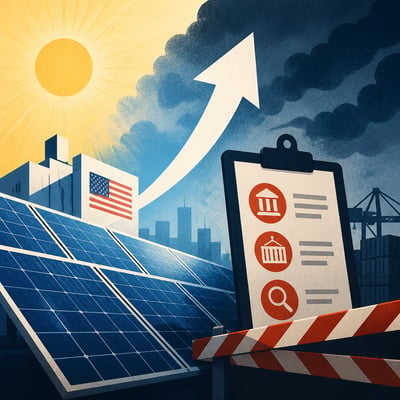
U.S. solar policy is being reshaped by new subsidy restrictions, especially rules affecting China-linked ownership and control. The result is less financing, tighter supplier screening, and more uncertainty for domestic manufacturing even as solar still leads new power capacity and storage grows alongside it.

 Climate
 Privacy
 Bob Dylan
 Drones
 Data Centers
 AI Governance
 2026 Maine Senate Race