History
07/22/20260 new articles
The update mainly sharpens the story around DOE's June 2026 selections, adding a clearer financing and project-stage picture rather than introducing a new direction. It also newly identifies the DOE Loan Programs Office and a West Virginia proposal as still lacking a confirmed site and electricity customers.
07/22/20260 new articles
The story is largely unchanged, but the framing has shifted slightly toward the uncertainty around whether federal coal support will translate into real capture or storage. The current version also broadens the description of project stages and emphasizes DOE's carbon-dioxide utilization agenda more explicitly.
07/22/20260 new articles
DOE’s coal-linked carbon management support has become more concrete, with named projects selected across multiple locations and funding directed to feasibility and design work. The emphasis also shifts more clearly toward carbon utilization, while uncertainty remains over whether these coal projects will actually reach capture deployment.
- DOE selected four coal projects for carbon-capture-related work.
- TerraSpark received $18.5 million for feasibility and design work.
- Selected projects span Puerto Rico, Maryland, Alaska, and West Virginia.
- DOE emphasized carbon utilization for manufactured goods and oil production.
- New projects remain uncertain on technical, permitting, and commercial grounds.
06/29/20260 new articles
The story has shifted from a broad policy realignment around coal and carbon management to a more specific account of DOE financing carbon capture infrastructure and early deployments, alongside criticism that some coal-linked support may not guarantee real capture outcomes. The emphasis is now less on delay and uncertainty and more on whether federal funding architecture will actually produce emissions reductions.
06/13/20263 new articles
The story now centers more sharply on an active federal push to recommission coal assets and pair some new or revived coal projects with carbon capture, rather than mainly on broad carbon-management support. At the same time, direct air capture and carbon-removal efforts look increasingly delayed and exposed to subsidy and financing uncertainty.
- Coal recommissioning and modernization are now explicit funding priorities.
- New or revived coal projects are pairing generation with carbon capture.
- Subsidy reviews are directly affecting carbon removal programs.
- The policy frame increasingly treats CO2 as an industrial input.
- Current implementation is described as more fragmented than earlier targets suggested.
05/11/2026Topic Formed
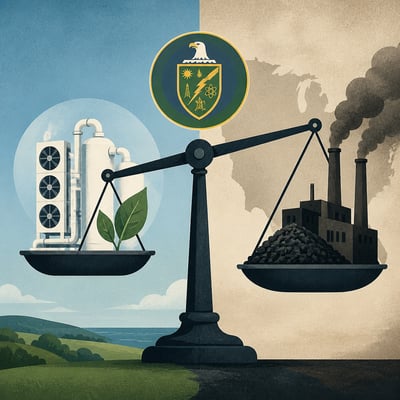
The cluster centers on U.S. Department of Energy carbon management funding, especially the tension between support for carbon capture/direct air capture deployment and a newer move to redirect some of that money toward recommissioning or modernizing coal plants. The current state is shaped by policy conflict over statutory intent, implementation delays, and uncertainty around whether carbon management funds will accelerate emissions-reduction infrastructure or prolong coal operations.

 Climate
 Privacy
 Bob Dylan
 Drones
 Data Centers
 AI Governance
 2026 Maine Senate Race