History
07/22/20261 new articles
The story has broadened from general U.S. geothermal scaling efforts into a more specific picture of where enhanced geothermal is advancing and which project types are emerging. The biggest new development is the addition of concrete demonstrations and use cases, especially Fervo’s projects, Cornell’s direct-heat test, and Vermont’s shared heat-pump network.
06/29/20261 new articles
The story now places much more weight on concrete policy execution: Congress, the Interior Department, and several states are actively moving geothermal from a planning theme into permitting, procurement, and cost-recovery changes. It also adds a clearer commercialization angle, with modular systems and broader non-hotspot deployment becoming central to the narrative.
- U.S. House passed geothermal cost-recovery legislation.
- Sage Geosystems is promoting modular geothermal systems.
- Nevada advanced a clean transition tariff supporting geothermal.
- Colorado is expanding geothermal grants and tax-credit-style support.
- Public-land permitting cost recovery is now a central federal policy mechanism.
06/17/20263 new articles
The story has broadened from policy momentum around geothermal permitting and procurement into evidence of actual project execution and commercial contracting. Next-generation geothermal is now framed less as a future policy objective and more as an emerging deployment pipeline tied to specific developers, buyers, and use cases beyond power alone.
- Fervo Energy and Cornell are now cited as projects moving into deployment.
- Utility-linked geothermal procurement deals are newly emphasized.
- Direct heating and district-heating use cases are now part of the story.
- Clean Energy Alliance appears as a new procurement actor.
- The framing now stresses clean firm power as a complement to solar and wind.
06/09/20263 new articles
The story now emphasizes active federal and state regulatory movement, not just policy interest: permitting reform, lease cadence, and administrative support have become central alongside California procurement and exploration support. It also adds clearer political and industry actors driving execution, including Congress, Interior, and named developers.
05/22/20263 new articles
The story has shifted from broad policy support for geothermal to a more specific de-risking agenda centered on subsurface uncertainty, test-bed drilling, and early-stage financing. California now stands out as the main proving ground, while repurposed oil and gas wells emerge as a new parallel pathway.
05/15/2026Topic Formed
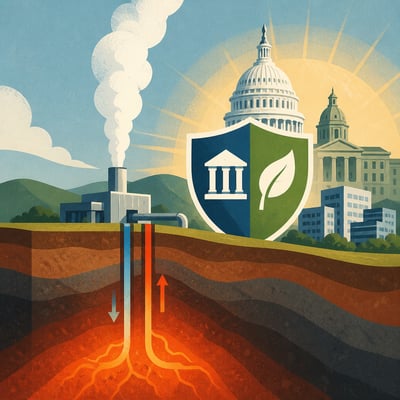
U.S. next-generation geothermal is gaining policy support through state procurement, federal permitting, and new R&D proposals, but it still remains a small share of electricity supply. The strongest signal is a shift from technical promise toward market and regulatory mechanisms that could make clean firm geothermal easier to finance and deploy.

 Climate
 Privacy
 Bob Dylan
 Drones
 Data Centers
 AI Governance
 2026 Maine Senate Race