History
07/23/20260 new articles
The biggest update is that the Google project is now explicitly pegged at $15 billion, and the story has broadened to include a separate North Carolina Amazon campus as a comparison point. The core Missouri dispute remains the same, with transparency, water, power, and infrastructure concerns still driving local resistance.
07/23/20260 new articles
The story now adds concrete implementation and legal details: Google’s energy and infrastructure commitments are more specific, and AWS is now directly tied to a Sunshine Law lawsuit. The framing also sharpens around public transparency and utility planning rather than just general local opposition.
- Google will provide a $20 million energy affordability fund.
- Google says it will fund its electricity and infrastructure needs.
- AWS faces a Sunshine Law lawsuit filed by Preserve Montgomery County.
- Google has proposed more than one gigawatt of new generation capacity through Ameren.
- Missouri Gov. Mike Kehoe is now explicitly tied to the project.
07/22/20262 new articles
The story has become more concrete and contentious: the Missouri data center buildouts are now tied to named projects, a specific 1,900-acre footprint, and clearer concerns about power, water, and public approvals. The latest version also adds active local opposition and a Sunshine Law lawsuit, sharpening the legal and procedural scrutiny.
- Named projects: Google’s Project Spade and AWS’s Project Green.
- Combined footprint reported at about 1,900 acres.
- Google contracted with Ameren for over 1 gigawatt of new generation capacity.
- AWS project linked to estimated 49 million gallons of annual well-water use.
- Lawsuit alleges Montgomery County Sunshine Law violations.
06/29/20261 new articles
The story has sharpened from a general Missouri data-center buildout into a more concrete, higher-stakes account of two massive campus projects, with new detail on investment size and community pushback. The latest version also adds a lawsuit and more explicit local scrutiny, making transparency and legal conflict more prominent.
- Google’s proposed campus is now pegged at $15 billion.
- Amazon’s campus is described as several billion dollars.
- A March 2026 lawsuit alleges Sunshine Law violations.
- Residents are using records requests and meetings to scrutinize the projects.
- Ameren Missouri is now explicitly identified as a utility partner.
06/21/20266 new articles
The story has shifted from a general buildout narrative to a more concrete phase centered on deal terms: Google and Amazon’s Missouri projects now appear tied to explicit power-cost commitments, tax-abatement negotiations, and community-benefit packages. The main change is that the projects look operationally and politically further along, with local governments and residents focusing more on who pays and who benefits.
- Projects are now described as moving forward in Missouri.
- Google and Amazon will cover electricity and related infrastructure costs.
- A proposed 70% personal property tax abatement is under discussion for Google.
- Community-benefit commitments include workforce training and energy assistance funds.
- Coverage now includes Jackson County, Alabama as a separate Google expansion.
06/17/20265 new articles
The story has shifted from a general account of two hyperscale projects to a more specific picture of an actively advancing buildout, with new emphasis on land assembly, utility cost allocation, and legal/political pushback. Reporting now suggests the county corridor is becoming a tightly concentrated AI infrastructure zone rather than just a pair of planned campuses.
06/16/20265 new articles
The story has sharpened from a general dispute over adjacent hyperscale projects into an active Montgomery County megasite buildout, with Google now under construction and Amazon still in planning review. The framing also places more emphasis on concrete power sourcing, tax structures, and local approval mechanics rather than just broad opposition.
05/30/20265 new articles
The story has broadened from a single Google buildout into a two-company Montgomery County hyperscale campus, with Amazon's adjacent project now reshaping the core issues. The debate has also become more contentious, centered on tax abatements, water, and approval transparency rather than just power and jobs.
- Amazon Web Services is building an adjacent hyperscale project.
- Nearly 2,000 acres are now being discussed for the combined site.
- A 70% personal property tax abatement is being proposed for Google equipment.
- Residents and groups are pursuing lawsuits and hearings over transparency.
- AWS planning has triggered sharper groundwater questions.
05/21/2026Topic Formed
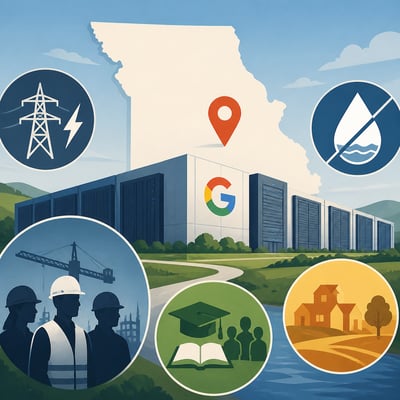
Google has announced a $15 billion hyperscale data center project in New Florence, Missouri, centered on Montgomery County. The project is being framed around economic development, with thousands of construction jobs, long-term operations jobs, workforce training partnerships, and a community energy fund. A major part of the story is power: Google says it will pay for all electricity and related infrastructure costs tied to the facility under Missouri rules, while also contracting new generation capacity with utility partners. The company also says the site will use advanced air-cooling to limit water use.

 Climate
 Privacy
 Bob Dylan
 Drones
 Data Centers
 AI Governance
 2026 Maine Senate Race