
 Climate
 Privacy
 Bob Dylan
 Drones
 Data Centers
 AI Governance
 2026 Maine Senate Race
Orbital Data Centers Face Scaling Hurdles
Coverage from Axios, Ars Technica, and others
Articles
17
Active Days
68
The Topic
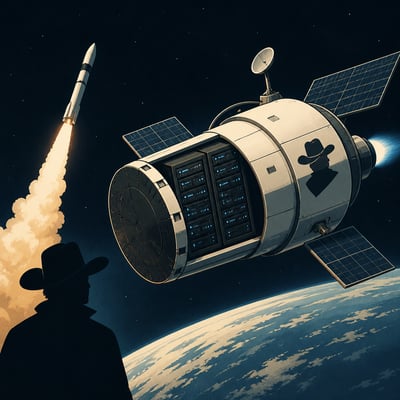
Companies including SpaceX, Blue Origin, Google, Orbital, Starcloud, and Cowboy Space are advancing proposals or tests for solar-powered data centers in low Earth orbit. The approach could reduce dependence on terrestrial power, land, water, and permitting, but large-scale deployment still depends on cheaper and more frequent launches, lightweight cooling systems, radiation-tolerant hardware, reliable communications, and workable maintenance models. Current evidence points to small demonstrations and delay-tolerant or space-generated workloads before orbital facilities can complement, rather than replace, ground-based data centers.
First Article: 05/11/26
Latest Article: 07/17/26
Summary
- SpaceX, Blue Origin, Google, Orbital, Starcloud, and Cowboy Space are pursuing competing orbital-computing concepts, with no proposal fully approved by the FCC.
- SpaceX has described a potential constellation of up to 1 million satellites, while Blue Origin and Orbital have proposed constellations of roughly 51,600 and 100,000 satellites, respectively.
- Orbital systems could use near-continuous solar power and avoid some terrestrial grid, land, water, and permitting constraints.
- Heat rejection is a central design problem because orbital hardware must radiate heat rather than use Earth-based air cooling; radiator mass and area directly affect economics.
- Launch capacity and price remain major dependencies, with the largest concepts requiring rapid reusable heavy-lift launches and satellite manufacturing at unprecedented scale.
- Latency, limited communications capacity, radiation, debris, thermal cycling, and difficult repairs favor local, asynchronous, or space-generated workloads over tightly synchronized cloud computing.
- The near-term path is more likely to involve demonstrations and modest deployments than football-field-sized orbital server farms.
History
The story has shifted from a speculative set of orbital data-center ideas to a more concrete phase of proposals and tests, with clearer timelines and added participants. It also now emphasizes regulatory non-approval, near-term demonstrations, and the operational path to commercialization.
The story has broadened from a few orbital-data-center proposals into a more concrete industry map, with new actors like Google, Starcloud, and Orbital joining and several companies now tied to specific constellation sizes, test programs, and regulatory filings. The update also sharpens the technical view by emphasizing that these systems are more likely to support specialized, delay-tolerant workloads than replace terrestrial data centers.
Featured
Timeline: 68 Days
Hover over any logo to see coverage summary, click for full article.