
 Climate
 Privacy
 Bob Dylan
 Drones
 Data Centers
 AI Governance
 2026 Maine Senate Race
Orbital Data Centers Face Scaling Hurdles
Coverage from Axios, Ars Technica, and others
00/00/0000
Articles
17
Active Days
68
The Topic
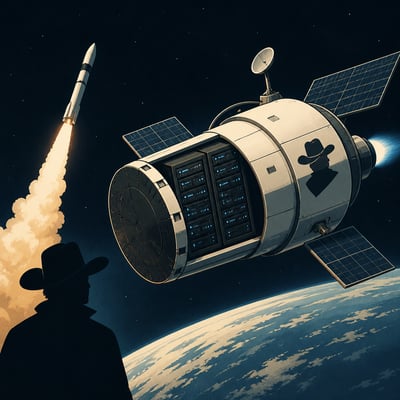
Companies including SpaceX, Blue Origin, Google, Orbital, Starcloud, and Cowboy Space are advancing proposals or tests for solar-powered data centers in low Earth orbit. The approach could reduce dependence on terrestrial power, land, water, and permitting, but large-scale deployment still depends on cheaper and more frequent launches, lightweight cooling systems, radiation-tolerant hardware, reliable communications, and workable maintenance models. Current evidence points to small demonstrations and delay-tolerant or space-generated workloads before orbital facilities can complement, rather than replace, ground-based data centers.
First Article: 05/11/26
Latest Article: 07/17/26
History
The story has shifted from a speculative set of orbital data-center ideas to a more concrete phase of proposals and tests, with clearer timelines and added participants. It also now emphasizes regulatory non-approval, near-term demonstrations, and the operational path to commercialization.
The story has broadened from a few orbital-data-center proposals into a more concrete industry map, with new actors like Google, Starcloud, and Orbital joining and several companies now tied to specific constellation sizes, test programs, and regulatory filings. The update also sharpens the technical view by emphasizing that these systems are more likely to support specialized, delay-tolerant workloads than replace terrestrial data centers.
- Google is developing Project Suncatcher concepts for orbital machine learning.
- Starcloud has tested an Nvidia H100 GPU in orbit.
- Orbital filed for up to 100,000 AI data center satellites.
- SpaceX seeks authorization for up to one million satellites.
- No orbital data center proposal has received full FCC approval.
The story has become more concrete around specific financing and regulatory steps, with Cowboy Space's funding and Blue Origin's FCC filing making the orbital data-center push feel more operational. At the same time, the framing now emphasizes broader feasibility constraints beyond launch and thermal management, especially economics and long-term in-orbit operations.
- Cowboy Space raised $275 million at a $2 billion valuation.
- Blue Origin filed with the FCC for a large low-Earth-orbit constellation.
- Operational risks now include radiation damage and in-orbit servicing.
- Early use cases may be niche, space-related workloads instead of mainstream replacement.
- Chip cost is now cited as a major feasibility constraint.
The story broadened from a mostly Cowboy Space-led financing and regulatory narrative into a denser, multi-player field with additional startups and major space/tech names testing orbital data center concepts. The current version also shifts emphasis toward prototype planning and near-term feasibility questions, not just capital raising and filings.
- Sophia Space and Google-linked efforts newly appear in the story.
- Cowboy Space now has a 20,000-satellite constellation target.
- Cowboy Space is described as aiming for 2028 deployment.
- Near-term prototype schedules are now part of the narrative.
- The story now frames orbital compute as a way to bypass terrestrial water and land limits.
The story broadens from Cowboy Space’s standalone orbital data-center push into a wider, more contested space-compute race that now includes Blue Origin-linked efforts and explicit timeline skepticism. The emphasis also shifts further toward financing and regulatory execution, with the main question becoming whether launch, thermal, and FCC constraints can be overcome.
- Cowboy Space has raised $275 million.
- Blue Origin-linked orbital data center efforts are now part of the story.
- Jeff Bezos is now directly associated with timeline caution.
- Target deployment windows extend into 2027 and 2028.
- FCC filings still leave satellite design and licensing unfinished.
The story has shifted from an ambitious orbital AI-compute concept to a more execution-oriented buildout, with new emphasis on rocket hardware and early technical demonstrations. It also adds a clearer regulatory path by bringing FAA launch licensing into the frame alongside FCC approvals.
The story has advanced from a general orbital-data-center concept to a more concrete financing-and-regulatory push for orbital AI infrastructure. The biggest new development is the disclosed $275 million Series B alongside the FCC filing for a 20,000-satellite Stampede constellation, which sharpens the scale and execution path.
- $275 million Series B was raised.
- FCC filing was made for the Stampede constellation.
- The system is now framed as orbital AI compute infrastructure.
- A one-megawatt orbital data center target is set for 2028.
- Launch constraints are driving proprietary rocket design interest.
The story has shifted from a general orbital-data-center buildout to a more concrete regulatory and technical roadmap, with a much larger planned constellation now foregrounded. The new version also emphasizes NVIDIA-linked demo hardware and FCC approval steps as the key near-term milestones.
- FCC filings outline a 20,000-satellite Stampede constellation.
- Phased deployment requirements are now part of the regulatory plan.
- NVIDIA Space-1 Vera Rubin modules are part of the LEO compute demo.
- Power-beaming tests from orbit to ground are explicitly planned.
- Cowboy Space is now described as raising capital.
Cowboy Space is building a vertically integrated business around orbital data centers, combining launch vehicles, in-space compute, and power systems. The company says launch capacity constraints and terrestrial power limits make it more economical to design its own rocket upper stages as data-center platforms. Near-term work centers on technology demonstrations, FCC filings, and a planned first launch by the end of 2028.