History
07/23/20260 new articles
The main change is a reframing of SpaceX’s AI effort as a more explicit commercial business, with recurring revenue from Anthropic and Google now emphasized alongside continued Texas expansion. The orbital satellite plan is largely unchanged in substance, but the new version narrows the open questions to schedule, scale, economics, insurance, and financing.
07/23/20262 new articles
The story has shifted from a primarily orbital-data-center proposal to a more concrete commercial compute business, with SpaceX now emphasizing large terrestrial AI capacity in Tennessee, Mississippi, and Texas alongside the satellite effort. The update also adds clearer execution signals, including Texas staffing and manufacturing preparation, while confirming the orbital case is still economically and technically uncertain.
- SpaceX is exploring at least one large Texas data center.
- Some data center staff have been moved to Texas.
- Colossus and Colossus II exceed 1 gigawatt combined.
- Insurance brokers and underwriters are now involved in orbital risk discussions.
- Gigasat and Terafab are linked to AI1 production planning.
07/22/20261 new articles
The story has shifted from mostly a speculative orbital-compute concept into one with concrete commercial traction: SpaceX now has major terrestrial AI customers that could help fund the effort. That makes the orbital program look more connected to an operating business, even though the core technical and financing risks remain unresolved.
- Google agreed to use about 110,000 Nvidia GPUs at SpaceX facilities.
- Anthropic agreed to pay $1.25 billion per month through May 2029.
- FCC approval is sought for up to one million AI1 satellites.
- AI1 uses onboard compute, laser links, and deployable liquid-radiator cooling.
- Insurance discussions have begun for orbital data center companies.
06/29/20261 new articles
SpaceX’s AI story has shifted from a mostly conceptual orbital-data-center ambition to a more concrete program with disclosed satellite design, regulatory filings, and supporting manufacturing capacity. The current version also makes the ground infrastructure buildout more explicit, suggesting execution is starting to matter as much as vision.
- Disclosed AI1 orbital satellite design.
- FCC application filed for a large satellite constellation.
- New manufacturing capacity in Austin and Bastrop.
- Ground-side Terafab and Gigasat facilities support the AI program.
- Terrestrial compute assets remain part of the strategy.
06/21/2026Topic Formed
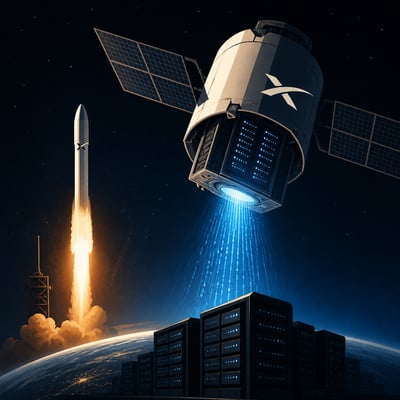
SpaceX’s IPO filing places AI infrastructure at the center of its next phase, backed by large compute contracts, major capital spending, and a push into orbital data centers. The company is monetizing existing data center capacity while also describing a longer-term effort to build satellite-based compute systems in space. The topic is shaped by strong growth ambitions, but also by heavy losses, governance concentration around Elon Musk, and unresolved technical and economic questions.

 Climate
 Privacy
 Bob Dylan
 Drones
 Data Centers
 AI Governance
 2026 Maine Senate Race