
 Climate
 Privacy
 Bob Dylan
 Drones
 Data Centers
 AI Governance
 2026 Maine Senate Race
U.S. Drone Delivery Expands Beyond Pilots
Coverage from ScienceDirect, The Salt Lake Tribune, and others
00/00/0000
Articles
38
Active Days
159
The Topic
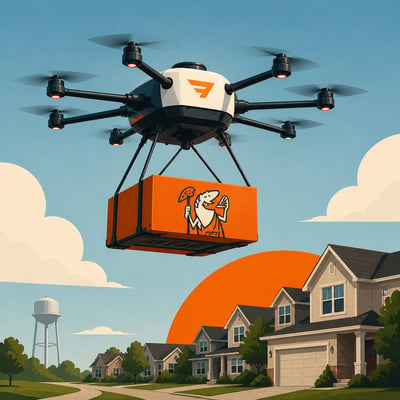
Drone delivery is moving from isolated demonstrations toward broader commercial use in U.S. grocery and restaurant logistics. Wing is expanding its Walmart service into additional markets, while Flytrex is using larger drones for family-size meal deliveries and testing automated coordination with Wing in shared airspace. The expansion is still limited by payload, range, weather, regulation, restaurant workflows, and the economics of operating at scale.
First Article: 04/26/26
Latest Article: 10/01/26
History
The story now shows drone delivery as a more mature commercial service, highlighted by Wing and Walmart surpassing 1 million deliveries and Wing’s expansion still pending in some announced markets. It also adds a new restaurant use case, with Papa Johns testing Wing delivery in North Carolina and starting with sandwiches because pizza packaging and payload limits remain constraining.
The story has shifted from broad expansion of drone delivery networks to evidence of more mature, coordinated operations: Wing and Flytrex are now testing shared-airspace coordination at scale while pushing larger restaurant deliveries and broader market coverage. The new material also adds a novel logistics angle, with research suggesting drone deliveries could be supported by ride-hailing or taxi vehicles as mobile launch infrastructure.
- Wing and Walmart plan expansion to nearly 20 U.S. markets.
- Flytrex and Wing coordinated nearly 10,000 overlapping flights monthly.
- Sky2 can deliver two large pizzas plus additional items.
- Restaurant workflows and packaging must be adjusted for drone delivery.
- Research explores using ride-hailing vehicles as mobile drone infrastructure.
The story now emphasizes that drone delivery is moving into repeat, scaled commercial use rather than just broader pilot expansion, especially through Wing’s million-plus deliveries and Flytrex’s Texas infrastructure buildout. It also adds stronger evidence that regulatory approval and local compliance are the key constraints, alongside economics and ordinance limits.
- Wing has surpassed 1 million commercial deliveries.
- Flytrex opened a manufacturing and maintenance facility in Pilot Point.
- Flytrex is using a higher-payload drone for Little Caesars pizza orders.
- FAA BVLOS approval is enabling expansion beyond pilot zones.
- Noise rules and local ordinances remain unresolved deployment constraints.
The story has shifted from broad multi-market drone-delivery expansion to a more specific picture of operational scaling centered in Texas, especially Dallas-Fort Worth. The new emphasis is on commercial execution details—shared-airspace coordination, BVLOS constraints, and larger-payload aircraft—rather than just geographic rollout.
- Wing-Walmart target footprint exceeds 270 locations by 2027.
- Flytrex expansion centers on Dallas-Fort Worth with the Sky2 drone.
- Texas is the main operational anchor for current deployments.
- Automated coordination is being used to avoid overlapping flight conflicts.
- Companies are opening facilities and integrating ordering systems with dispatch.
The story now emphasizes a much larger, more operationally mature rollout, led by Walmart-Wing’s expansion into seven more metro areas and evidence of repeat commercial use at scale. It also adds a clearer second lane for the market: higher-payload food delivery, especially via Flytrex and Little Caesars, while highlighting regulatory and local coordination as the main constraints.
- Walmart and Wing are expanding into seven additional U.S. metro areas.
- Wing reports more than 1 million commercial deliveries.
- Flytrex and Little Caesars are enabling larger-payload food delivery routes.
- Ordering now runs through integrated Walmart and Wing apps and systems.
- Expansion targets extend into 2027.
The story has shifted from a general account of drone delivery scaling to a more specific, current commercialization narrative centered on Wing and Walmart’s multi-metro expansion and Flytrex’s vertical integration. The emphasis is now less on restaurant pilots and more on repeatable service networks supported by manufacturing, maintenance, and retail-linked infrastructure.
- Wing and Walmart are expanding drone delivery into several new U.S. metro areas.
- Flytrex is adding manufacturing, maintenance, and site capacity tied to Sky2.
- Adjacent infrastructure now includes drone nests, fenced pads, and automated recharge systems.
- Ordering and point-of-sale integration is now explicitly part of the operating challenge.
- Wing is now presented as the broadest network operator.
The story has shifted from a set of localized pilots to a clearer scaling narrative, with Flytrex and Wing now framed as building repeatable delivery networks and supporting infrastructure for BVLOS operations. The main new emphasis is regional expansion in Dallas-Fort Worth and Charlotte, plus the operational systems needed to make drone delivery routine.
- Service models are shifting from pilots to repeatable delivery networks.
- Flytrex expansion now includes manufacturing-linked scaling capacity.
- Wing and Flytrex are tied more explicitly to BVLOS-enabled operations.
- Dallas-Fort Worth and Charlotte are the main regional growth areas.
- Restaurant integration now includes customer communication, not just ordering systems.
The story shifts from a narrow focus on food-delivery pilots to a broader picture that now includes retail delivery and a more clearly regulated suburban operating model. Wing’s North Carolina footprint is also more explicitly expanded through additional local pilots.
The story has sharpened from general suburban drone-delivery pilots into a more explicitly operational scaling narrative, with better-defined use cases and tighter integration with restaurant systems. The main new emphasis is on execution details and controlled expansion, rather than any fundamentally new market or regulatory breakthrough.
The story has shifted from a general account of expanding suburban drone food delivery to a more concrete example of execution: Flytrex and Little Caesars have launched higher-capacity pizza service in Wylie, Texas, while Wing’s North Carolina testing remains limited to smaller menu items. The emphasis is now more clearly on specific operational constraints and rollout choices rather than broad expansion.
The story now emphasizes that drone food delivery is not just expanding, but becoming operationally embedded through app-linked ordering and kitchen-system integration. The framing also sharpens around geographically constrained, suburban commercial pilots as the practical model that is actually working.
The story shifts from emphasizing pilots and constraints to showing a more operationally mature network of repeatable local drone delivery services. Wing’s North Carolina activity is broader than before, and the framing now highlights execution details like handoff, dispatch, and order integration as the key scaling challenge.
The story has broadened from a single Flytrex pizza-delivery rollout to a wider pattern of restaurant drone logistics, now including Wing and Papa Johns. The emphasis has shifted toward operational constraints and repeatable suburban deployment rather than just one higher-payload service.
- Wing and Papa Johns are testing autonomous delivery in North Carolina.
- The initial menu includes sandwiches and Papadias rather than full pizza boxes.
- Packaging design and last-mile logistics are now central constraints.
- Deployments are described as operating in narrow geofenced suburban service zones.
- The story now spans Charlotte-area markets in North Carolina.
The main update is a reframing from a general drone delivery launch to a more specific, higher-capacity suburban operation carrying family-sized pizza orders. The story also adds clearer regulatory and execution detail, including FAA Part 135 framing and automated recharge at the base.
The cluster is primarily about a live commercial drone delivery rollout centered on Flytrex and Little Caesars in Wylie, Texas. The dominant pattern is operational deployment of a higher-payload delivery drone for restaurant meals, with repeated emphasis on short-range suburban delivery, app-to-kitchen integration, BVLOS-enabled operations, and precision navigation. The signal is coherent and current, with little historical drift.