The Jerusalem Post04-28-2026
Amer Hujirat was killed on Tuesday in southern Lebanon during a Hezbollah drone strike while Ziv Medical Center in Safed reported the incident Wednesday.
The Jerusalem Post04-26-2026 Hezbollah launched two drones toward IDF troops in southern Lebanon on Sunday during evacuation, killing Sgt. Idan Fooks after an explosive drone impacted near stretcher loading.
The Jerusalem Post05-14-2026 Hezbollah-linked explosive FPV drone strike on Thursday injured three civilians in Rosh Hanikra, prompting IDF plans for FPV suicide drone production.
The Jerusalem Post05-25-2026 IDF launched long-range strikes on Tyre Monday evening after Hezbollah drone attacks on Israel, including an explosive drone hit in Metula.
The Jerusalem Post05-26-2026 Israel confirmed deeper IDF infiltration into Lebanon beyond the April 17 Yellow Line on Tuesday as Hezbollah continued drone attacks on IDF forces and northern Israel.
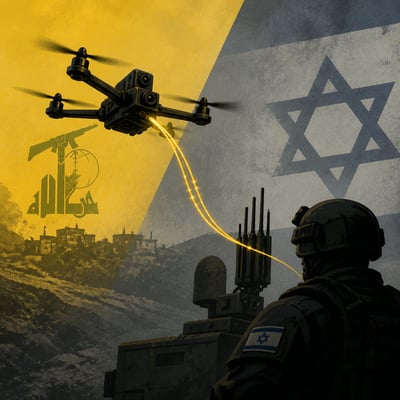
The Jerusalem Post06-05-2026 Opinion piece says Hezbollah in Lebanon shifted to fiber-optic-guided drones that are harder to jam, prolonging drone and rocket attrition in northern Israel.
The Jerusalem Post07-26-2026 On Sunday, the IDF shot down a Hezbollah unarmed camera drone in southern Lebanon while Israel’s Security Cabinet discussed a potential total drone-use ban.
 Al Jazeera / Daniel Khalili-Tari05-31-2026
During Israel's expanded ground invasion of southern Lebanon in 2024, Hezbollah claimed drone attacks, including fiber-optic drones designed to resist jamming and evade radar detection.
Al Jazeera07-10-2026 Lebanon's National News Agency reported two injuries from an Israeli drone strike during garbage unloading near Choukine and Kfar Dajjal on Thursday as Amnesty International pressed for war-crimes investigations.
 Haaretz04-29-2026
Israeli soldiers and the Israel Defense Forces described Hezbollah explosive drones as a growing threat during contractor demolition guarding in southern Lebanon.
 ynetglobal / Elisha Ben Kimon06-21-2026
IDF reconnaissance forces in Majdal Zoun, southern Lebanon, uncovered an Iranian-funded underground drone and weapons tunnel after monthlong airstrike and ground operations.
 The New Arab04-27-2026
Hezbollah used fibre-optic-equipped explosive-laden FPV drones in southern Lebanon on Sunday, killing Israeli soldier Idan Fooks and prompting Israeli artillery and airstrikes.
 i24 NEWS05-25-2026
IDF reports multiple deaths from Hezbollah explosive drone strikes between southern Lebanon and the Israeli border, with countermeasures reportedly developed after the campaign began.
Ynetnews / Gal Ganot05-21-2026 IDF reported FPV drone strikes in southern Lebanon wounded ten Israeli soldiers in a morning attack and a separate evening strike, as Hezbollah expanded FPV use.
Ynetnews07-27-2026 IDF intercepted two drones near the Jordanian border on Monday morning before entry into Israel, with launch origin under investigation and no reported impact inside Israel.
ynetglobal04-26-2026 Israeli Sgt. Idan Fooks was killed in a drone strike in southern Lebanon, with additional explosive drones intercepted during evacuation and Hezbollah infrastructure struck after the incident.
ynetglobal05-11-2026 Israeli forces reported FPV drone attacks launched from Lebanon near the border, killing Alexander Glovanyov and wounding reserve soldiers, while deploying net-based trapping and interception support.
ynetglobal / Alexandra Lukash05-11-2026 In northern Israel near the Lebanese border, an explosive-laden FPV drone launched from Lebanon detonated and killed reservist Alexander Glovanyov, wounding three reservists near Shlomi.
ynetglobal / Boaz Haetzni05-31-2026 The analysis argues Israel and Hezbollah face asymmetric battlefield risk from fiber-optic guided drones after Ukraine shows mass drone attrition effects.
ynetglobal / Elisha Ben Kimon06-28-2026 IDF destroyed Hezbollah's underground tunnel network in Majdal Zoun, Lebanon, on Sunday night after finding dismantled drones and launch shafts aimed at Israel.
ynetglobal / Yossi Yehoshua06-29-2026 Israeli forces destroyed Hezbollah’s Majdal Zoun underground drone base during Operation Final Word, after later troops found Iranian-made drones and launch shafts previously assessed as inactive by Air Force intelligence.
 The Media Line04-26-2026
Hezbollah launched an explosive drone during an Israeli security-zone operation in southern Lebanon, killing Sgt. Idan Fooks and wounding six soldiers amid an extended April 17 ceasefire.
The Media Line05-08-2026 IDF reported Friday that Hezbollah explosive drones wounded four soldiers, followed by a Nahariya school UAV discovery and IDF event cancellations in northern Israel.
 Times of Israel / Emanuel Fabian06-21-2026
Israeli troops raided a Hezbollah underground UAV facility in Majdal Zoun, Lebanon, and recovered Iranian Qasef drones reportedly designed to strike Israel.

 Climate
 Privacy
 Bob Dylan
 Drones
 Data Centers
 AI Governance
 2026 Maine Senate Race